

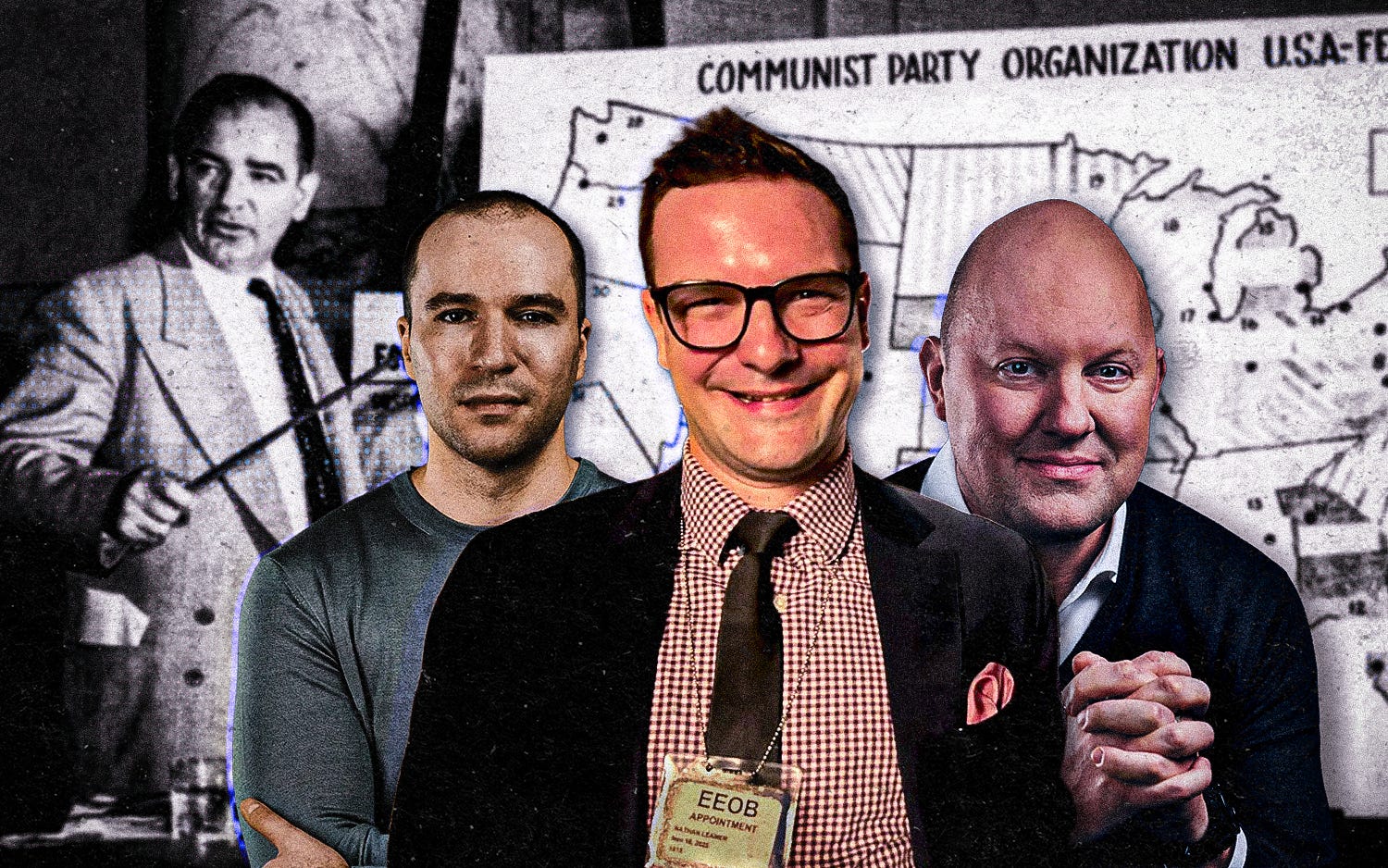
Nathan Leamer’s Twitter bio is only ten words long: “Suburban Dad. Work at intersection of tech and public policy.” He’s being too modest. Leamer is executive director of a group called Build American AI, which is backed by the super PAC Leading the Future, which in turn is backed by people like OpenAI President Greg Brockman (to the tune of $25 million) and venture capitalist Marc Andreessen (via his VC firm A16Z) and Palantir co-founder Joe Lonsdale.
Though Leamer seems not inclined to talk about his job, his Twitter feed offers some clues about his duties. One of them, apparently, is depicting influential critics of AI in a negative light. This week Sen. Bernie Sanders hosted a livestream conversation called “The Existential Threat of AI and the Need for International Cooperation.” Joining Sanders were two American AI safety advocates and two AI experts from China—one from Tsinghua University (aka “China’s MIT”) and one from the Beijing Institute of AI Safety and Governance. Leamer tweeted this analysis: “Bernie Sanders decided to let 2 members of CCP-controlled organizations zoom into his anti innovation party at the Capitol.”
Leamer also circulated commentary by other analysts. One tweet he retweeted said that 20,000 people had tuned in “to watch a US Senator cater to the CCP on AI innovation in the US.” Another said: “Incredible to see a US senator endorsing America’s surrender to China.”
I think I sense a theme developing…
To understand why this theme will keep developing—why you’re going to see more critics of AI implicitly or explicitly cast as traitors, and why people like Brockman and Andreessen and Lonsdale underwrite this stigmatization—you have to understand that US-China cooperation isn’t the only, or even the main, thing about Sanders’s AI agenda that bothers them.
Along with Rep. Alexandria Ocasio-Cortez, Sanders has proposed legislation that would pause the construction of AI data centers in the US until Congress enacts AI safeguards. And a cardinal principle of AI accelerationist rhetoric is that any regulation that could slow the development of AI poses a grave threat to America by handicapping it in its presumably existential race with China. Both Americans who joined Sanders in his livestream have been on the NonZero podcast, and one of them, Max Tegmark of MIT, said during our podcast conversation, “Companies in the US have found that by far the easiest way to avoid being regulated is just to say this two-word sentence: ‘But China!’ And then regulators back off.”
So, for Silicon Valley, a machine that smears advocates of regulation as unpatriotic is a dual-use technology: It discourages international agreements that could slow AI down and cut into revenue, and it discourages national regulation that could slow AI down and cut into revenue. Nathan Leamer is, among other things, part of that machine. I hope the job pays well.
And it should! It keeps him busy. When he’s not tweeting, he’s doing things like helping journalists with their research. This week, for example, he was quoted by New York Post columnist Lydia Moynihan in support of her assertion that “AI doomerism—the belief that advanced AI poses an existential threat to humanity—has quietly forged one of the stranger coalitions in modern politics. Socialists, Hollywood unions, Jan. 6 organizers and Chinese government officials are now aligned in trying to slow down American AI development under the guise of saving humanity.”
I don’t want to overdo the distinction between national and international regulation. With this technology, especially, the two are often connected organically. Even if you favor Sanders’s data center moratorium, you have to acknowledge that its effectiveness will be limited by the fact that data centers can be built abroad. Or, to take a proposal that would have a better chance of enactment than a data center moratorium: If you put a heavy tax on data centers, more data centers will be built abroad, so the tax will have slowed things down only modestly and so will buy us only a little more time to ponder and wisely calibrate AI governance. The natural solution would be an international agreement on a minimum data center tax; effective national governance would entail international governance.
This international tax idea isn’t as crazy as it may sound. The Biden administration pushed for an international minimum tax on multinational corporations to stem the “race to the bottom” that encourages countries to lower taxes in hopes of attracting companies. And 136 nations agreed to a 15 percent minimum tax!
The big and fatal obstacle—as is often the case with worthwhile international initiatives—was the US itself. But most of the domestic opposition came on the Republican side, and much of that came from MAGA Republicans—and many MAGA Republicans are alarmed about AI. (Hence that reference to “Jan. 6 organizers” in the New York Post.) On the same day Tegmark appeared on the Bernie Sanders livestream, he appeared on Steve Bannon’s podcast. So maybe it’s not too wild a dream to imagine a left-right coalition that supports not just national but international AI regulation.
Granted, it’s a pretty wild dream. MAGA Republicans are traditionally averse to global governance in general and cooperation with China in particular. Bannon, when cutting to commercial breaks, sometimes plays a song called “Take Down the CCP.” And I’m pretty sure that if we hold off on the international governance of AI until we see regime change in China, we’ll have waited too long. This week the New York Times ran a story about how helpful consumer-grade AI can be to the aspiring bioweapons maker—and pandemics, like many other bad things AI could foster, don’t respect borders.
Is McCarthyism too strong a word for the tactics of AI industry operatives like Leamer? Well, Leamer is certainly no Joseph McCarthy. He hasn’t, for example, tried to get anybody fired on grounds of ideology. And, Leamer aside, I don’t expect to see anything comparable to the Hollywood blacklists. Fear of China isn’t as intense or widespread as fear of Soviet communism became after World War II.
Still, trying to discredit people with groundless accusations or insinuations of aiding and abetting an enemy (real or imagined) is, among other things, antithetical to the principles of liberal democracy. (The House Un-American Activities Committee, whose investigation of Hollywood in the late 1940s foreshadowed McCarthy’s rise as a red-baiter, certainly earned its name!) Plus: The US tech industry—much to its benefit—includes many people of Chinese ancestry, and they should be able to choose and vocalize their positions in the AI debate without worrying that their ethnicity will make that endeavor particularly perilous. And even when Leamer’s cheap shots, as in this case, aren’t directed at people of Asian ancestry, they still help create an atmosphere in which that peril may be felt.
Few psychological forces are more corrupting of rational debate, or more conducive to oppression and persecution, than the suspicion that members of your tribe are in league with a tribe that’s been deemed an enemy. And this is an especially destructive force to unleash if you’re in the middle of a technological revolution which demands that humankind, for its own good, do a better job of transcending nationalism and other forms of tribalism than it’s ever done before. If I seem hypersensitive to signs of McCarthyism, part of the reason is that I think that’s what we’re in the middle of.
PS I elaborate on my argument that the AI revolution demands a war on tribalism—and suggest some ways to fight that war—in the closing chapters of my book The God Test, which comes out next month. You can pre-order here if you’re so inclined.



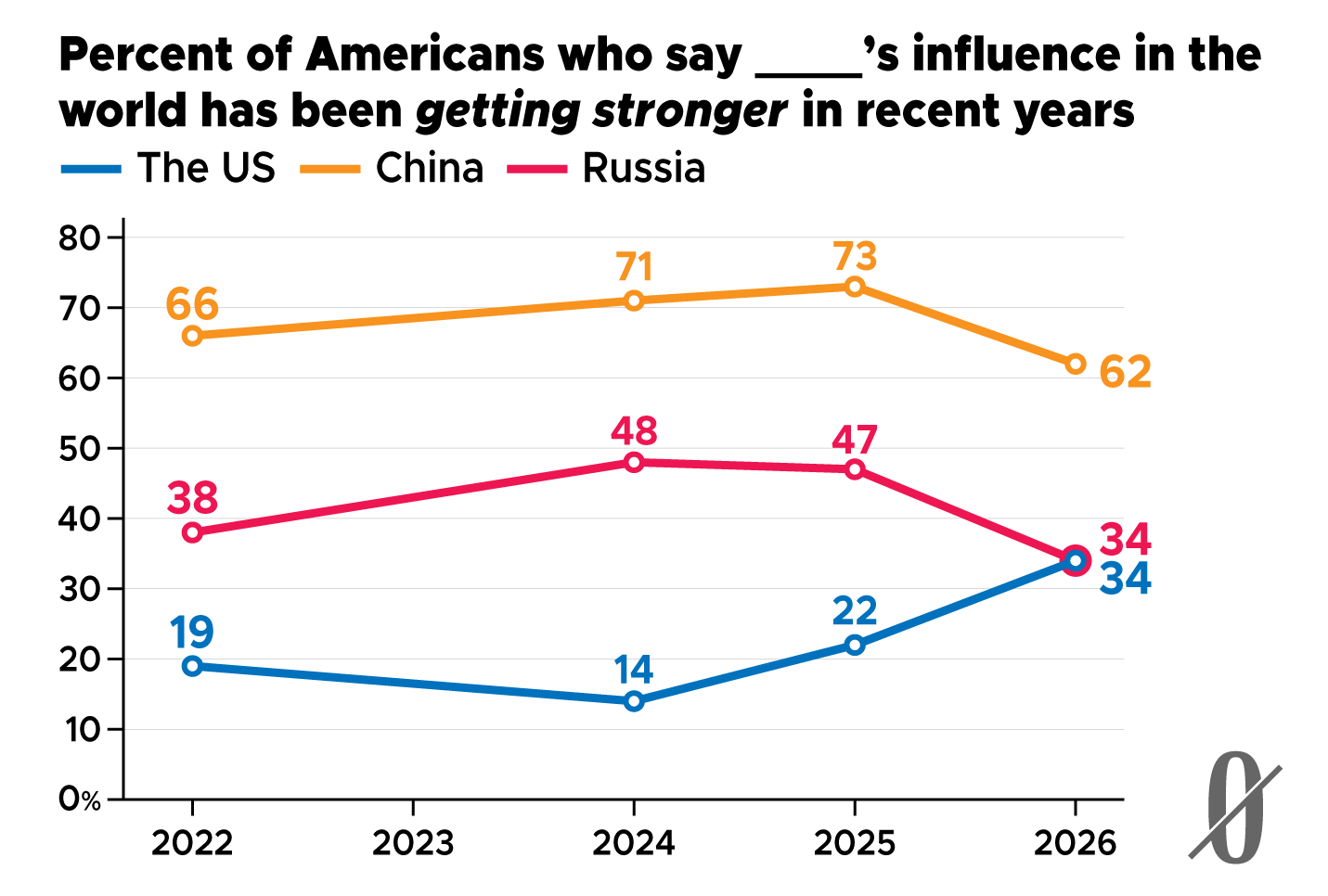
Good news for President Trump! Since he was inaugurated last year there has been an increase in the number of Americans who think US influence in the world has been strengthening! What’s more, the final data point in the graph above comes from late March—nearly a month into the Iran war. So maybe Americans are rejecting the view, widely held abroad, that the war illustrates a declining American ability to use its power effectively. Or maybe, on the other hand, Americans who answered this survey question noted that it didn’t specify whether the influence was for good or ill.
In any event…
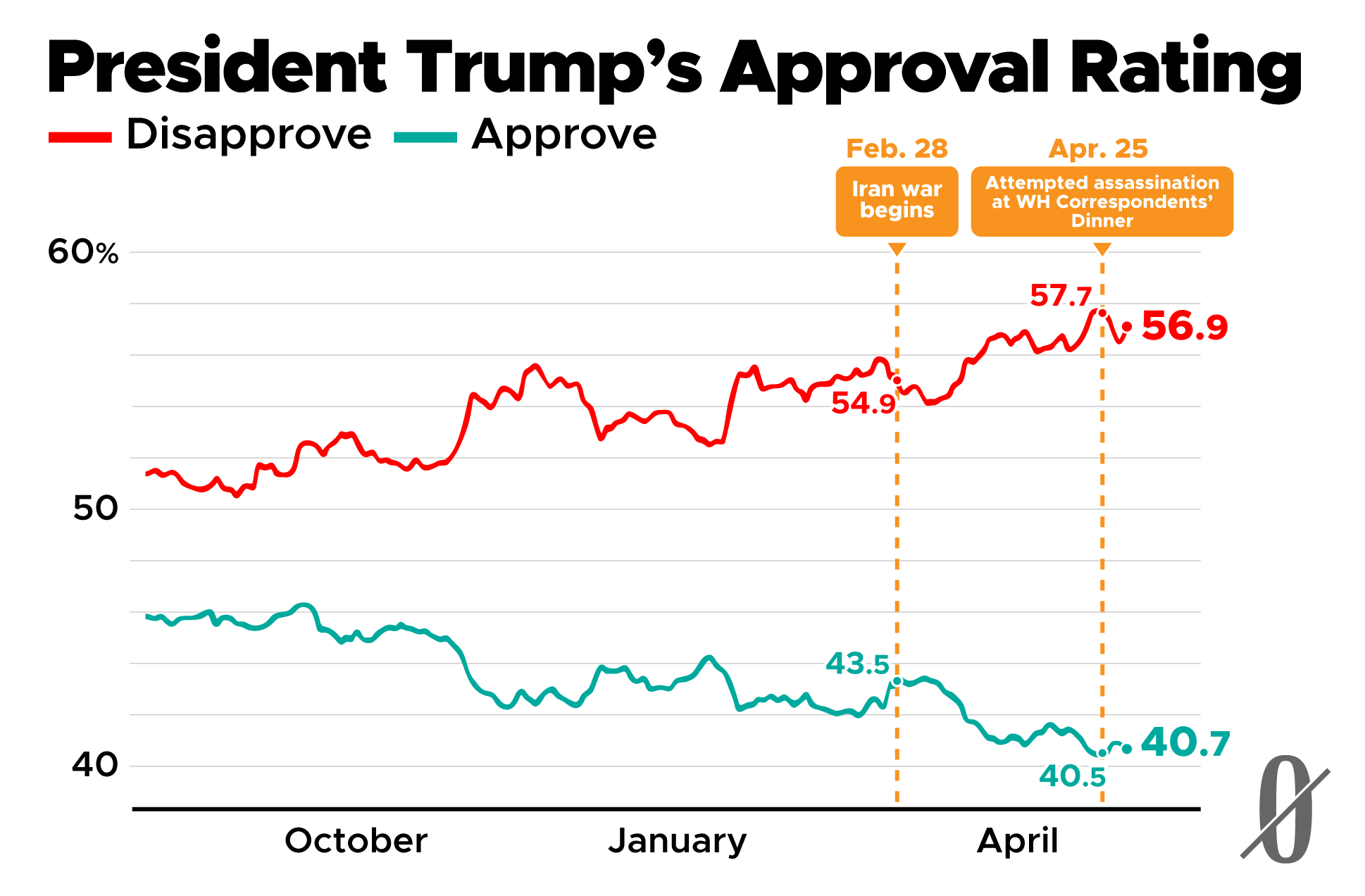
The graph below suggests that the war isn’t proving very popular among Americans. Trump’s attack on Iran brought a rally-round-the-flag effect, and so did the attempted attack on Trump last week. But the first of those two effects faded entirely, and the second is showing signs of doing the same.
Banners and graphics by Clark McGillis.
Almost half of Americans appear to be happy that Trump is our president. That continues to astonish me.
Interesting read from China: https://academic.oup.com/nsr/article/13/8/nwag204/8644097