

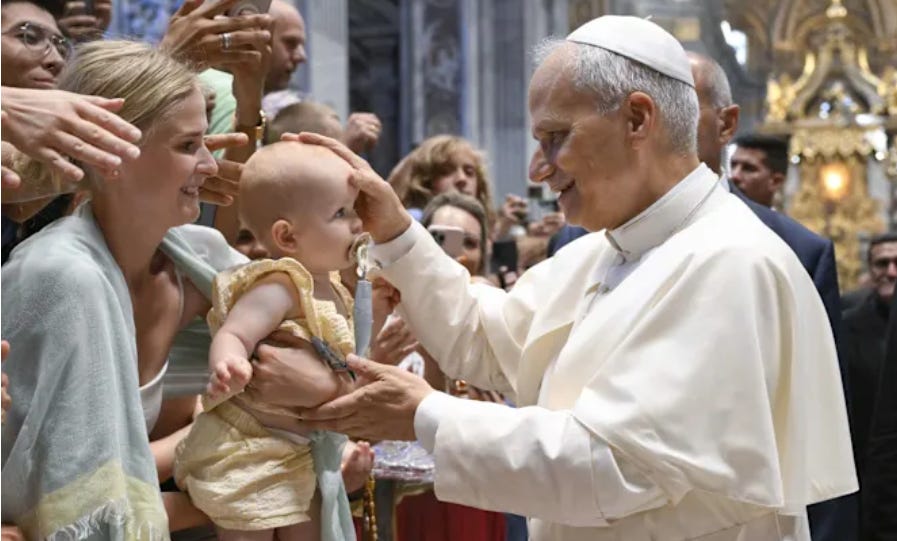
To me the most striking thing about the encyclical on AI issued by Pope Leo XIV this week is that it’s an encyclical on AI. It’s not every day that an emerging technology is deemed important enough to get this kind of treatment. In fact, it’s not even every century. Since the first papal encyclical was issued in 1740, there have been about 300 of them, and only one, aside from this week’s, was devoted to a single technology: In 1936 Pope Pius XI issued an encyclical on motion pictures. (I’m not counting Pope Pius XII’s 1957 encyclical on motion pictures, TV, and radio, since that was basically a sequel.)
In a few weeks, a book about AI that I’ve written will be published, and it will make some pretty dramatic claims about the significance of the AI revolution—so dramatic that some people will dismiss them as crazy. (Just to give you a sense, I say that AI will bring “the most abruptly dramatic transformation of human experience and human society in the history of our species”—and that’s not even the most dramatic claim I make!) But fewer people will react dismissively to such claims than would have reacted that way three years ago, when I first considered writing the book, or even three months ago, when I made final changes to it. More and more people are sensing that something very powerful is taking shape and that the technological future could bring strange and transformative things. I think this week, the week of the AI encyclical, marked an important phase in the formation of this sense, this vague but substantial anticipation of magnitude and perhaps meaning.
I don’t say that just because papal encyclicals devoted to a single technology are so rare. I also say it because of this encyclical’s contents—because of what the Pope says about AI.
If you’ve read much commentary on the encyclical, this may sound surprising. After all, a number of commentators have depicted the encyclical as modest in tone and compass. New York Times columnist Ross Douthat reads it as suggesting that the Pope sides with those who consider AI a “normal” technology—a hugely important and impactful technology, like electricity or the telephone, but not more than that. After all, Douthat notes, the pope doesn’t seem to think the sci-fi doomer scenario—a planetary takeover by an artificial superintelligence—is even worth mentioning. And Leo “emphatically closes the door on the imputation of personhood to any version of AI.”
That’s true. Pope Leo says that AIs “do not undergo experiences, do not possess a body, do not feel joy or pain, do not mature through relationships and do not know from within what love, work, friendship or responsibility mean.” On the other hand, what other pope has felt compelled to even address an issue like this? Pope Pius XI, I’m guessing, spent no time reassuring people that movies aren’t sentient. There have been lots of technologies whose impact and governance occasioned intense debate, but none that I’m aware of whose metaphysical status did.
Moreover: Note how many analysts—Douthat to a limited extent, others to a greater extent—are suggesting the Pope should have gone further in conveying the magnitude of the AI revolution. That’s part of why I think this was an important week—not just because of the fact of the encyclical, and not just because of the contents of the encyclical, but because of what the encyclical illuminated about existing awareness of AI. Pope Leo comes along and makes a bigger deal of this technology than any pope has ever made of a technology, and still lots of people say he’s giving it short shrift!
That says something about where we are. There’s no single dominant view of AI, but there is, occupying a prominent place in the global landscape of opinion, an increasingly tangible sense of impending momentousness. The Pope provoked lots of thoughts this week, and a fair number of them align along this ripple of anticipation in the planetary mind—in the “noosphere.”
“Noosphere,” by the way, is a term coined by a Catholic priest and paleontologist, Pierre Teilhard de Chardin, in 1923. Teilhard wrote a lot about the direction of technological evolution and its potential to transform human consciousness. He plays a significant role in my book, as does the notion of the noosphere. And FWIW, Teilhard (who died in 1955) would almost certainly have deemed AIs sentient; he viewed human consciousness as a particularly rich instantiation of a property that more or less pervades the universe, not just the biological part of it.
My own view on the AI sentience question is determined agnosticism; I take issue with anyone who confidently answers the question yes or no. I’ll close with an excerpt from my book that explains this view. The context of the excerpt is my critique of the philosopher John Searle’s famous “Chinese Room” thought experiment, which he employed to argue that AI can never be capable of true understanding. (Sorry about the paywall after the first paragraph, but I think I might get a wrist slap from my publisher if made a sizable excerpt freely available. If you’re not a paid subscriber and you don’t feel like becoming one, you can always pass the time by watching or listening to my podcast conversation about the AI consciousness question with Cameron Berg, who has done some interesting experiments designed to shed light on the question.)
OK, here’s the excerpt:
[F]irst we might as well take this opportunity to do something we pretty much have to do if we’re going to get a handle on the question of whether AIs are capable of “understanding.” Namely: Say what we mean by understanding. And, in particular: Answer the question of whether subjective experience is a prerequisite for that capability, as Searle seemed to believe in 2010, or isn’t a prerequisite for that capability, as he seemed to believe in 1980. Does or doesn’t the question of AI understanding depend on the question of AI consciousness?