
The psychologist Jonathan Haidt has bad news for us. In a much discussed Atlantic piece called “Why the Past 10 Years of American Life Have Been Uniquely Stupid,” he lays out a view of our situation that’s grimmer than that grim title suggests—even if you throw in the grim subtitle: “It’s not just a phase.”
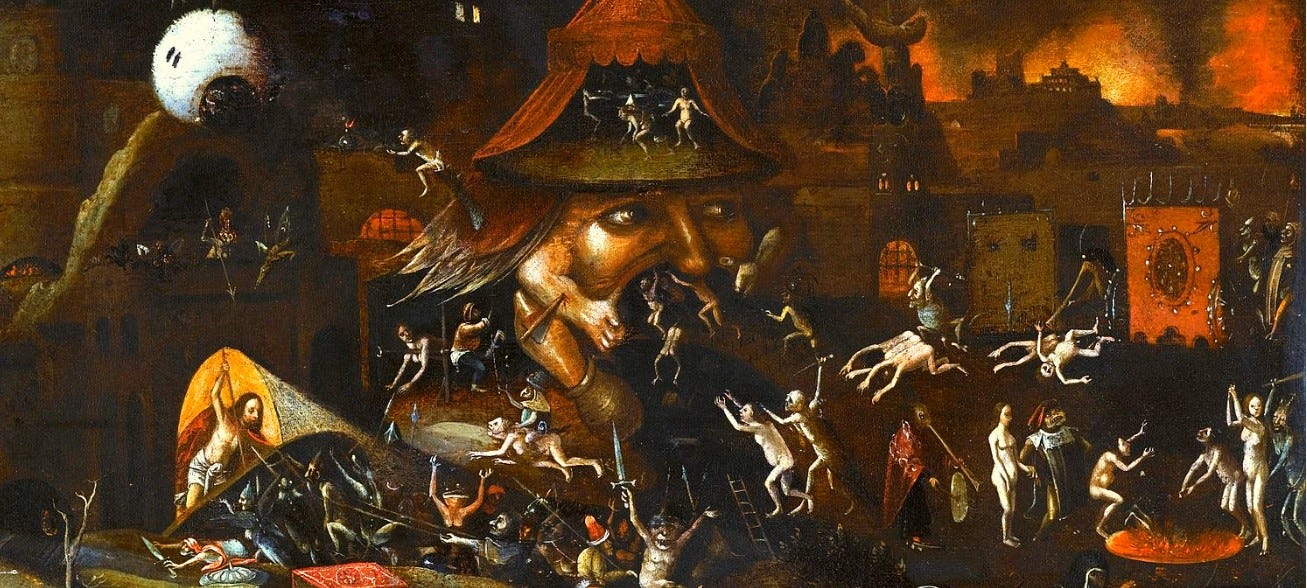
Haidt opens his piece (which is in the actual physical May issue of the magazine, as well as online) by invoking the biblical story of Babel—in which God sees that humans are building a tower to heaven and decides to teach them a lesson: He makes them speak different languages so that coordinating on future projects will be hard. Haidt reminds us that in some versions of the story, though not the biblical one, God destroys the tower, leaving people to wander through the ruins, “condemned to mutual incomprehension.”
“The story of Babel,” Haidt writes, “is the best metaphor I have found for what happened to America in the 2010s, and for the fractured country we now inhabit. Something went terribly wrong, very suddenly. We are disoriented, unable to speak the same language or recognize the same truth. We are cut off from one another and from the past.”
Wait. It gets worse.
Babel, he writes, is “a story about the fragmentation of everything. It’s about the shattering of all that had seemed solid, the scattering of people who had been a community. It’s a metaphor for what is happening not only between red and blue, but within the left and within the right, as well as within universities, companies, professional associations, museums, and even families… After Babel, nothing really means anything anymore—at least not in a way that is durable and on which people widely agree.”
There are three main culprits in Haidt’s story, three things that have torn our world asunder: the like button, the share button (or, on Twitter, the retweet button), and the algorithms that feed on those buttons. “Babel is a metaphor for what some forms of social media have done to nearly all of the groups and institutions most important to the country’s future—and to us as a people.”
I would seem uniquely positioned to cheer us up by taking issue with Haidt’s depressing diagnosis. Near the beginning of his piece, he depicts my turn-of-the-millennium book Nonzero: The Logic of Human Destiny as in some ways the antithesis of his thesis—as sketching a future in which information technology unites rather than divides. He writes:
“President Bill Clinton praised Nonzero’s optimistic portrayal of a more cooperative future thanks to continued technological advance. The early internet of the 1990s, with its chat rooms, message boards, and email, exemplified the Nonzero thesis, as did the first wave of social-media platforms, which launched around 2003.” Thereafter, it would seem, history was less kind to the Nonzero thesis.
Well, two things I’m always happy to do are (1) cheer people up; and (2) defend a book I’ve written. I’d like to thank Haidt (who is actually a friend—but whom I’ll keep calling “Haidt” to lend gravitas to this essay) for providing me the opportunity to do both at once.
But don’t let your expectations get too high about the cheering people up part—because, for starters, the book I’m defending wasn’t that optimistic. I wrote in Nonzero, “While I’m basically optimistic, an extremely bleak outcome is obviously possible.” And even if we avoid a truly apocalyptic fate, I added, “several moderately bleak outcomes are possible.”
Still, looking around today, I don’t see quite as much bleakness as Haidt seems to see. And one reason, I think, is that I don’t see the causes of our current troubles as being quite as novel as he does. We’ve been here before, and humankind survived.