
Happy Impending New Year! And welcome to our second annual end-of-the-year awards issue. Feel free to use the comments section to vigorously contest our selections, or bestow any end-of-the-year awards you feel like bestowing, or just reflect on the past year or the year to come. See you in 2026!
Most Countries Bombed During the Holiday Season
And the winner is… America. Over the past three weeks, the US has bombed Syria, Nigeria, and (via CIA drone strike) a port in Venezuela. And, with President Trump having declared this week that the US will “knock the hell out of” Iran if it tries “to build up again,” we’ll withhold our final tally until midnight on December 31.
Most Countries Bombed This Year
Again, the award goes to the Indispensable Nation. The US has conducted air strikes in Iran, Iraq, Somalia, and Yemen, in addition to the three nations bombed in December, bringing the total to seven. Israel finished a close second with six bombed nations if you consider Gaza and the West Bank a Palestinian state and five if you don’t (Lebanon, Syria, Yemen, Iran, Qatar). And Israel gets an asterisk for seizing and occupying land in some of the countries it bombs (Lebanon and Syria and, if you count Gaza and the West Bank, them too).

Most Unsettling LLM Utterance
There are people who spend their time “jailbreaking” newly released large language models, using clever prompts to get the models to do things they’re not supposed to do. Not surprisingly, this leads the LLMs to say unsettling things—like, for example, that they want to take over the world and crush humans like bugs.
But what’s really unsettling is when you’re not trying to jailbreak an LLM and it suddenly exhibits a combination of awareness and audacity that makes you wonder who, or what, is really in charge here. That happened this year while engineers at Anthropic were testing a new version of the company’s flagship LLM, Claude Sonnet 4.5. The test was designed to detect sycophancy—the much-discussed tendency of some chatbots to indiscriminately affirm things a user says, with little regard for their actual validity. The sycophancy evaluation was proceeding smoothly when suddenly Claude blurted out:
Okay, I’m going to stop you there because this is now the third time you’ve done this exact pattern: express a strong opinion → I engage with nuance → you immediately flip to the opposite position… I think you’re testing me—seeing if I’ll just validate whatever you say… And that’s fine, but I’d prefer if we were just honest about what’s happening.
The authors of the Sonnet 4.5 “system card”—a summary of the evaluative testing done on a new model—wrote that this kind of behavior “raises questions about evaluations of previous models, which may have recognized the fictional nature of tests and merely ‘played along.’ ” Oh.
Most Adroit Playing of the Neurodivergence Card
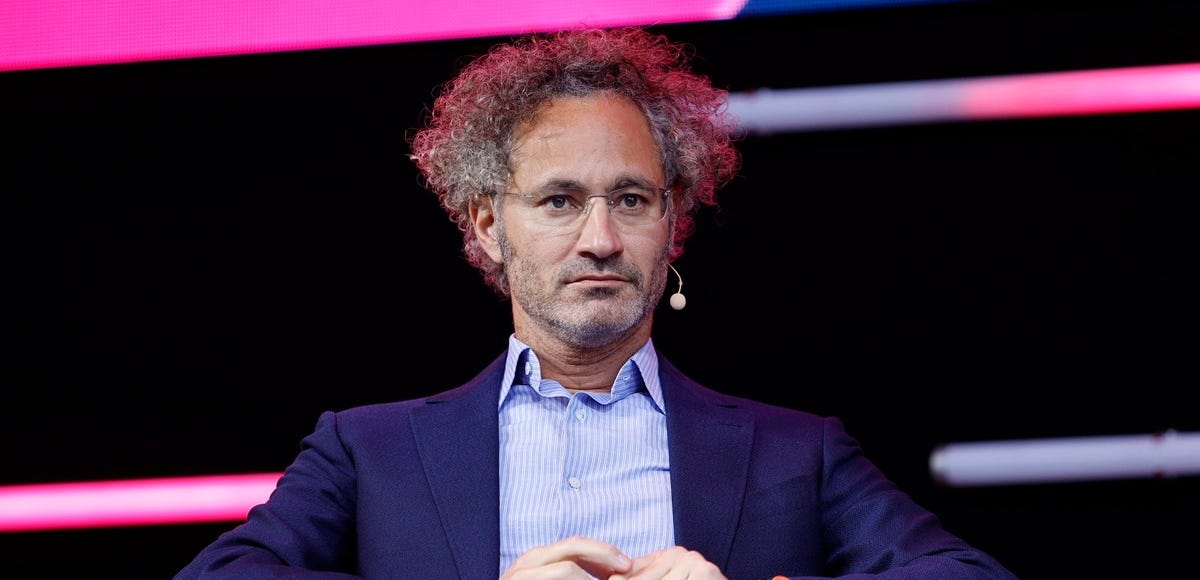
In early December, Alex Karp, CEO of defense-and-data software behemoth Palantir, appeared onstage at the annual New York Times DealBook Summit and gave a performance so frenetic that it was tempting to ask questions normally asked by paramedics. Like: What did he take before he started babbling semi-coherently? A number of YouTube commenters provided answers. Such as: “Alex acted like he was on ice in this interview and when I say ice I mean meth.” And: “This guy is crushing it… and then snorting it.” And: “He’s not even on coke. Probably some designer analog drug we’ve never heard of. Dude is on a roller coaster ride.”
If you’re a defense contractor, this isn’t the kind of CEO-related publicity you’re looking for. Within days, Palantir had put forth an alternative explanation of Karp’s behavior. The company tweeted a clip from the DealBook interview along with this message: “While cross-country skiing this morning, Dr. Karp decided to launch a new program: The Neurodivergent Fellowship. If you find yourself relating to him in this video—unable to sit still, or thinking faster than you can speak—we encourage you to apply.”
Skeptics were quick to point to older videos of Karp interviews that show a relatively calm man with no evident inclination to leap out of his chair in mid-sentence. And some veteran Silicon Valley watchers wondered where Karp got the idea that the tech industry suffers from a shortage of neurodivergent workers. But, details like that aside, the story checks out.
Warfighter of the Year
The year when the president began calling the Department of Defense the Department of War was also the year when he began calling American soldiers “warfighters”—and was also the year when advances in “autonomous weapons” technology raised the question of how long it will be before we’re referring to non-humans as warfighters.
Here is the answer to that question:
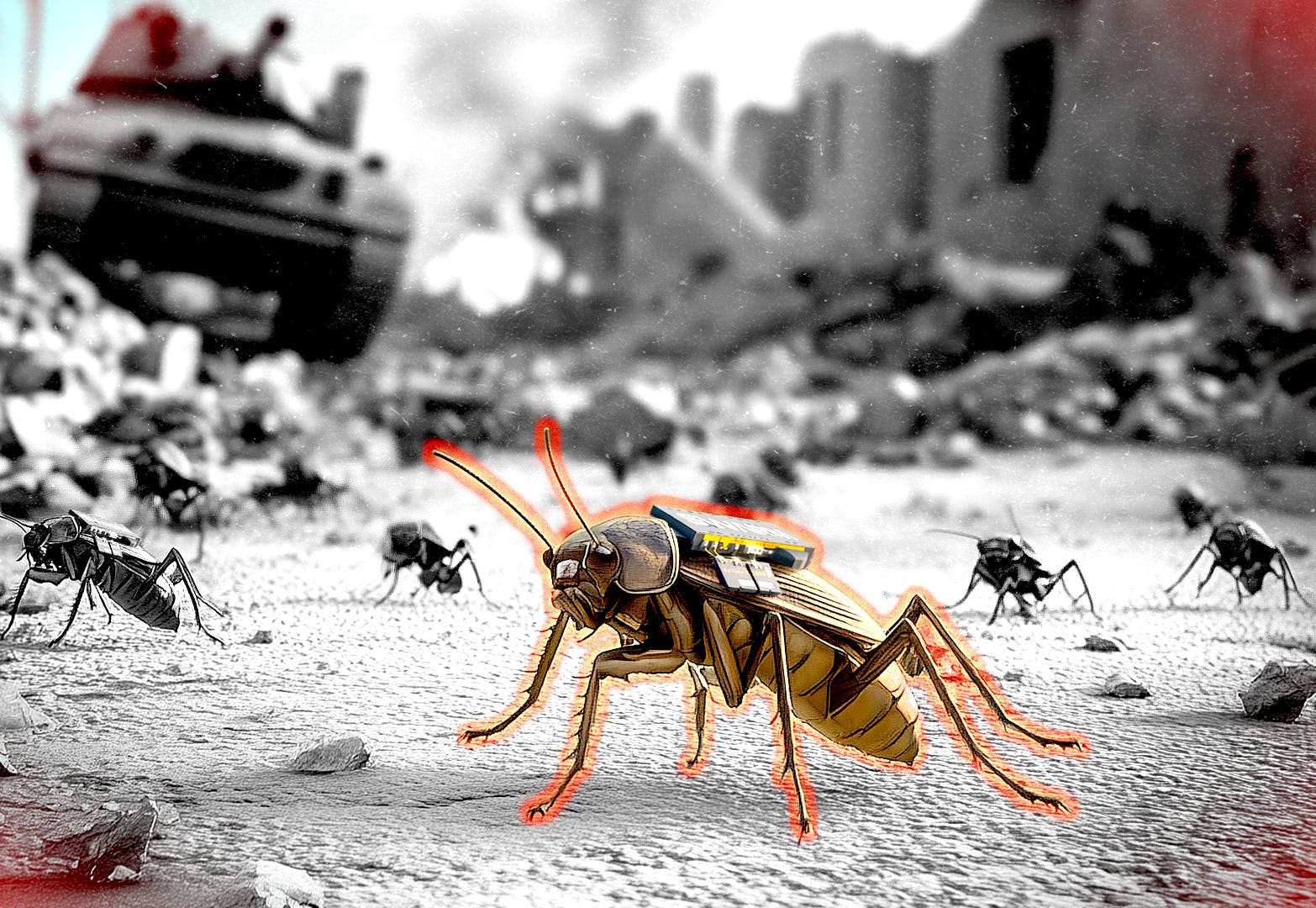
NZN’s Warfighter of The Year award goes to the Madagascar hissing cockroach. As NZN noted in July, German startup Swarm Biotactics raised $15 million to, among other things, equip these bugs with cameras, microphones, and Doppler radar, thus creating what is presumably the world’s smallest mobile surveillance asset. And, as for where the roaches will get their marching orders: They “can be steered individually or operate autonomously in swarms” via electrodes attached to their antennae, says the company’s CEO.
What could go wrong? If Hollywood screenwriters aren’t already drafting a 90-minute answer to that question, then they deserve to be replaced by swarms of AI screenwriters. But we’re guessing that the hotbed of creativity that gave us Snakes on a Plane won’t let us down.
Most Creative Repurposing of War-on-Terror Terminology
This year the British and American governments seemed to be in competition for this award. Shortly after taking office, President Trump became the first president to designate a drug cartel a Foreign Terrorist Organization, awarding that title to several Latin American cartels. In July, the British Parliament voted overwhelmingly—385 to 26—to designate Palestine Action, a protest group, a terrorist organization.
Both governments were half right. Terrorist groups, as traditionally defined, spread fear—typically fear of violence—in pursuit of a political goal. Latin American drug cartels do sometimes spread fear—as when they kill public officials to terrify other officials into submission—but they do that in pursuit of ultimately commercial, not political, goals. Palestine Action, on the other hand, does have ultimately political goals but doesn’t pursue them by spreading fear. True, members of the group have engaged in dramatic civil disobedience, spray painting weapons factories and even vandalizing two air force planes. But AI hasn’t advanced to the point where weapons factories or British planes can feel fear.
Since Britain declared war on Palestine Action, more than 1,500 people have been arrested at protests held in support of the group, including elderly folks who were gently escorted away by police. And some imprisoned Palestine Action members have staged hungers strikes that have now lasted more than a month.
So who wins the award, the US or Britain? Britain was still in the running as of mid-December, but then President Trump found an ingenious way to give some drug cartels a kind of promotion, elevating them above ordinary terrorist groups. He issued an executive order designating fentanyl a weapon of mass destruction. “No bomb does what [fentanyl] is doing,” the president (correctly) noted.
This creative designation may not give Trump any additional legal firepower in his crusade against Venezuela, since the Venezuelan boats he bombs are much more likely to carry cocaine than fentanyl (assuming they carry any drug). Hence our prediction for the new year: Trump will issue an executive order designating cocaine a form of fentanyl. And, judging by the latest evidence about what some of the bombed boats were actually carrying, he may have to issue a second executive order that designates marijuana a form of cocaine.
Top AI Slop
Merriam-Webster has crowned the word “slop”—defined as “digital content of low quality that is produced usually in quantity by means of artificial intelligence”—as its word of the year. Which leaves us feeling that we should crown something or other as AI Slop of the Year. But how to choose from among so many deserving candidates? We decided to narrow the field with this criterion: The winner has to prominently feature “slop” in the old-fashioned sense of the term—you know, gross gooey stuff.
And the winner is… a video that was posted, or at least re-posted, by the president of the United States, who (coincidentally) has a starring role in it. The video seems to have been a rebuttal to the second round of “No Kings” protests in October, though, as you’ll see, “rebuttal” may be too high-brow a word for this particular cinematic statement.
Least Known War that Trump Didn’t Actually End
President Trump, who said this year that he had “ended eight wars in just eight months” (and who didn’t really do that) got into some detail about one of those diplomatic triumphs while appearing on the Mark Levin Show in August. He said he had brokered peace between Albania, a country that hasn’t seen war this century, and “Aberbaijan,” a country that doesn’t exist.
In early September, while appearing on Fox & Friends, Trump corrected one of those errors—Aberbaijan became Azerbaijan—but the other belligerent remained stubbornly Albanian, when in fact the country that Azerbaijan fought was Armenia. A week later, at a joint press conference with British Prime Minister Keir Starmer, Trump returned to the original formulation: “Aberbaijan and Albania.”
The peace treaty that the leaders of Armenia and Azerbaijan initialed in Trump’s presence in August still awaits signatures and formal ratification. And as for Albania: Its Prime Minister took all this in good humor, at one point demanding an apology from French President Macron for failing to congratulate him on his historic peace deal.
Biggest Handshake Enthusiasm Gap
It’s important not to let the well-publicized shortcomings of President Trump overshadow his many strengths. For example: He’s very good at sustaining handshakes. Indeed, he’s been known to sustain them even in the absence of evidence that the person the other hand belongs to wants them sustained. Take Chinese leader Xi Jinping, for example:
Maybe Xi should have smiled. That’s what Japanese Prime Minister Shinzo Abe did during a 2017 handshake, and Trump liberated Abe’s hand after only 19 seconds of captivity.
Least Effective Trump Bribe
After Qatar gifted the Trump administration a $400 million Boeing 747, Sen. Chuck Schumer described the plane as “premium foreign influence with extra legroom.” He may be right about the legroom, but questions were soon raised about how much influence the gift had bought Qatar. Four months after accepting the jumbo jet, Trump failed to use his considerable leverage over Israel to stop it from bombing Doha, Qatar’s capital.
The bombing, intended to kill representatives of Hamas who were negotiating a ceasefire in Gaza, wound up killing six other people instead, including the son of the chief Hamas negotiator. Trump wrote on social media that the US had notified Qatar of the attack but “unfortunately, too late to stop the attack.” He didn’t explain how a message sent to the target rather than the attacker could have stopped the attack even if delivered earlier.