

Save the date: Next Saturday, November 14, at noon US Eastern Time, I’ll host a Zoom call with NonZero members (aka paid subscribers) about AI. Any and all AI-related thoughts and questions will be welcome. The Zoom link can be found below this post.
Nine months ago—two days after the killing of Renee Good by ICE agents in Minneapolis—I published a piece in this newsletter called “Some Useful Trump-Hitler Comparisons.” In it I wrote:
Incidents like the Renee Good killing can trigger mass reactions that Trump deems unruly enough to warrant countermeasures—Army deployments or National Guard deployments or additional ICE agents or maybe even loosened rules of engagement. (The New York Times reports that 100 more federal agents are now headed for Minneapolis.) Those countermeasures can lead to more mass reactions, more countermeasures, and so on. The danger of Trump, on the domestic front, isn’t that he’s Hitler or aspires to become Hitler, but that he has enough in common with Hitler to set in motion a very negative kind of positive-feedback cycle and then happily do what he can to sustain it, making good use, at key moments, of his contempt for the principles of liberal democracy.
Well, that didn’t happen. In fact, roughly the opposite happened: Trump retreated. True, it took a second Minneapolis ICE killing (of Alex Pretti), and widespread revulsion at both killings, for Trump to retreat. But it was still a retreat; he removed the ostentatiously macho commander of the Minneapolis operation, Gregory Bovino, and Bovino’s successor then reduced the size of the occupying force, deployed it less confrontationally, and ended the practice of stopping people semi-randomly and demanding proof of citizenship. The Minneapolis resistance—a bunch of ordinary people motivated by conscience—had collectively constituted Waterloo for Trump’s authoritarian onslaught, a fact that I hope future history books (or history bots, or whatever) will give due emphasis.
Of course, the Minneapolis resistance hadn’t addressed the threat in all its dimensions. Trump’s authoritarian initiatives had gone beyond deploying ICE agents to blue-state cities and encouraging them to play rough. Since the beginning of his second term he had exerted executive power in various unprecedentedly expansive ways and dared the courts to rein him in.
The good news was that Trump did, with a few short-lived exceptions, comply with court rulings. And, though some judges ruled in his favor, these weren’t the kind of favorable rulings that are most dangerous in a time like this, when a leader with authoritarian dreams wants to bend judges to his will. The more important of the favorable rulings tended to come from Republican-appointed judges who subscribed to the “unitary theory” of constitutionally endowed executive power. I’m not a champion of this theory, but some serious legal scholars support it, and in any event the main point is that these rulings reflected the longstanding intellectual (or, if you prefer, ideological) leanings of particular judges, not their response to some White House power play. Trump hadn’t succeeded in intimidating or otherwise manipulating the judiciary.
This pattern—Trump’s consistent failure to corrupt the courts—persisted through the runup to Tuesday’s elections. Numerous administration attempts to meddle in the voting process were rebuffed by judges, and the important American principle of state-level control of federal elections was upheld.
So on both fronts of Trump’s authoritarian assault—in the streets and in the courts—he failed. In that sense, Tuesday’s election was as important for what it was the end of as for what it may be the beginning of. As of 20 months ago, there was the real and increasingly vivid prospect of some kind of irreversible move toward authoritarian government during Trump’s second term. As of Wednesday morning that threat was nowhere to be seen.
But then…
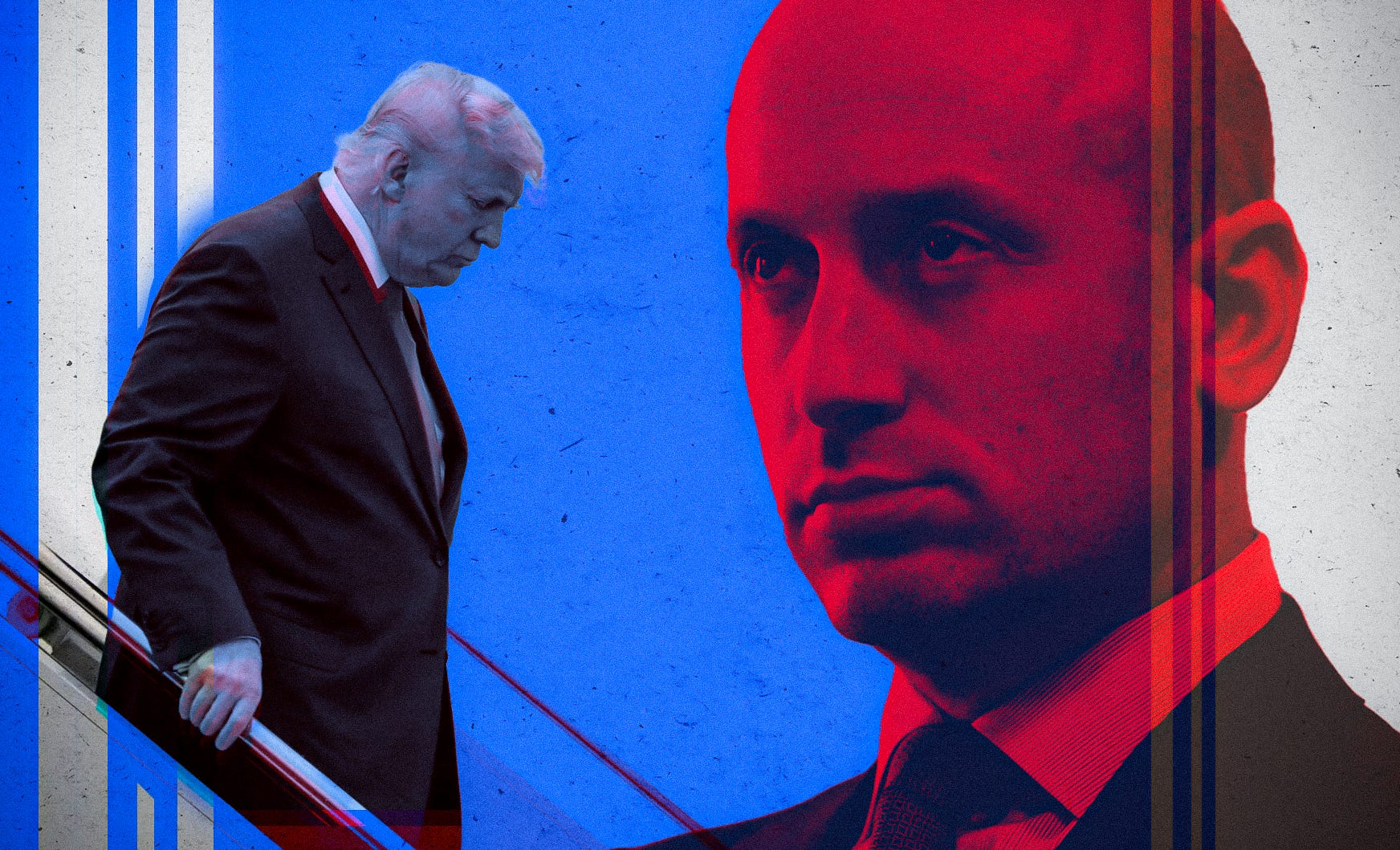
On Friday we learned that Susie Wiles, Trump’s chief of staff, would be replaced by Stephen Miller, who rivals Defense Secretary Pete Hegseth for the title of most influentially abhorrent person in the Trump administration and has long been the administration’s biggest backer of jack-booted thugs. If I had to choose one White House staffer as the personification of Trump’s deployment of violent force in Minneapolis and other blue-state cities, it would be Miller.
At the risk of further unsettling you: Even before I heard the news about Miller, I was in the process of penning a warning that the authoritarian threat posed by Trump hasn’t been vanquished. In fact, the rest of this piece was already in the process of being written and now appears pretty much as it would have appeared if the Miller news hadn’t broken.
Few things are more conducive to authoritarian takeover than national trauma. If a nuclear bomb of unknown origin went off in an American city next month, Trump, politically weakened though he’s been by Tuesday’s elections, would face little opposition in declaring martial law. And once somebody like him has cleared that hurdle, all bets are off.
I feel confident that we won’t see a nuclear detonation in America next month—or next year or the year after that. But there are other forms of national trauma—like, for example, economic trauma of the kind that smoothed Hitler’s rise to power. And various kinds of trauma are rendered more likely by the ongoing, and apparently accelerating, advance of artificial intelligence.
Many of these dangers have gotten a fair amount of attention and so aren’t worth dwelling on. Such as: A bad actor uses AI to build a new, genetically engineered bioweapon that triggers a pandemic much more contagious and lethal than Covid. Or: A bad actor uses AI to induce a cyber-catastrophe—like, say, crashing enough banks to trigger a financial panic or taking down lots of power grids along with some digital infrastructure, maybe rendering communication via cell phone or email impossible for large swaths of the population.
One AI threat that I think deserves more attention than it’s gotten doesn’t depend on “bad actors” for its realization. It just emerges from the effect of AI along multiple fronts: jobs, education, social life, family life, political discourse, and on and on. Each of these impacts can bring dislocation or disorientation. And, though adaptation to them is possible, it takes time—and meanwhile the collective impact could bring catastrophic destabilization. Or, failing that, it could bring destabilization that a president could persuasively call an existential emergency.
And then there’s geopolitical destabilization. In the interest of time I’ll spare you the details, except to say that, though this destabilization could emerge from AI, it could also emerge in a more traditional way. Right now there is an unresolved war with Iran that has already re-ignited a second war (Saudi-Houthis), while the Ukraine war shows no signs of ending. Both the Iran and Ukraine wars could in principle spread further, and even merge, and the global economic consequences could intensify.
Also: If a big terrorist attack in the US is attributed to Iran—regardless of whether the attribution is correct—I’m guessing that wouldn’t entirely spoil Stephen Miller’s day. Indeed, he might encourage such attribution if he thought it would give Trump an excuse to bring the hammer down.
OK, enough nightmare scenarios; you get the basic idea. But there’s one more nightmarish feature of AI that’s worth mentioning—its potential to help bring any given nightmare scenario to a dark culmination, help convert national trauma into authoritarian rule.
AI can allow whole new levels of surveillance and persuasive propaganda and other forms of thought control. So you wouldn’t want the world’s most powerful AI to be in the wrong hands. And, actually, I’m not sure it isn’t already there. Both OpenAI and Anthropic are said to have very powerful unreleased models, and the degree and nature of any administration access to such models isn’t as transparent as I’d like. In any event, you can certainly imagine the Trump administration demanding, and getting, full access to unreleased models in the wake of some national trauma.
Here is a famous quote from the science fiction writer Frank Herbert, spoken by one of the characters in his novel Dune: “Once men turned their thinking over to machines in the hope that this would set them free. But that only permitted other men with machines to enslave them.” I’m sure Herbert expected that quote to strike people as creepy. I’m less sure that it would strike someone as creepy as Stephen Miller that way.
I don’t want to get too grim here. Tuesday brought real cause for celebration: Over the past 21 months, fundamental principles of the American republic that were threatened by Trump have proven resilient. So let the festivities continue! But before long we’ll need to get back to work.
For starters, we’ll need continued vigilance against Trump’s illiberal power plays. Ominously, less than an hour before the Miller announcement, the Wall Street Journal published a piece about an administration plan to label some nonprofits as terrorist organizations, thus ending their tax-exempt status. If Trump proceeds with this and rolls out his list of targeted NGOs, I’m guessing that their terrorist inclination will turn out to be less clear-cut than their opposition to some aspect of Trumpism.
But what may be the most important arena of anti-authoritarian activism over the next two years is in the realm of AI. The goal here isn’t just to make sure the administration doesn’t use these increasingly powerful machines in authoritarian ways; it’s also to keep the machines from creating the pretext for such use. Which means figuring out how to govern them wisely and, in the meanwhile, slowing down their evolution—both to give us more time to work on the governance challenge and to make their coming social, psychological, economic, and political impact more gradual and so less jarring.
Relatedly: If you want to check out my book on AI, The God Test, you can read the introductory chapter and excerpts from all other chapters at thegodtest.net.
Banners and graphics by Clark McGillis.
And here’s that Nov 14 Zoom link: