

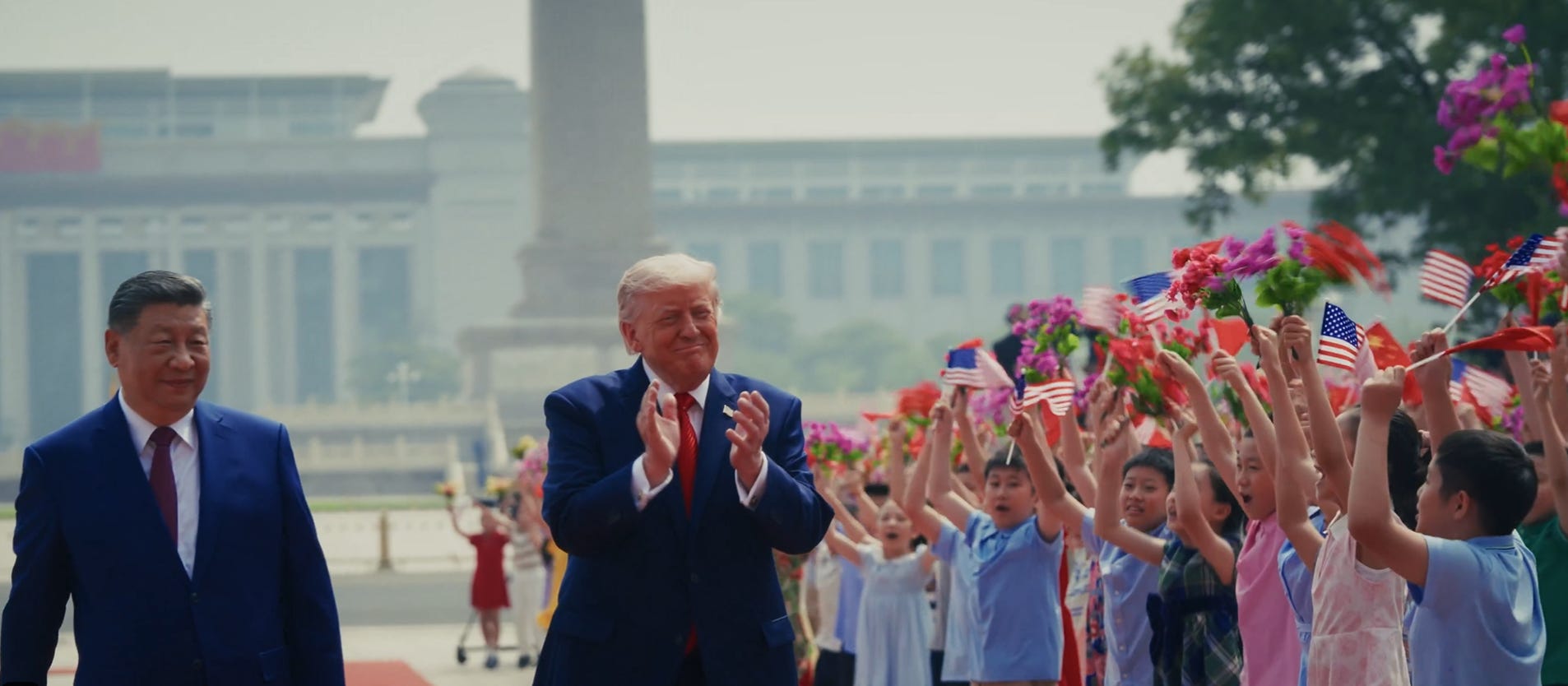
On Thursday the White House issued a social media post that said simply, “American strength back on the world stage.” You might expect such a post to be accompanied by military imagery—maybe an impressive-looking array of soldiers. And this one was. But the soldiers weren’t American. Smartly clad People’s Liberation Army troops, part of the pageantry that had greeted Trump in Beijing, were featured in the opening montage of a video that then showed Trump shaking hands with President Xi Jinping and ended with the two leaders walking side by side on a red carpet.
Apparently the unipolar moment is over. Being one of the world’s two main poles is, these days, the highest geopolitical aspiration of America’s president. “It’s the two great countries,” Trump proudly told Sean Hannity in an interview that aired on Fox News after the US-China summit ended. “I call it the G-2. This is the G-2.”
The US foreign policy establishment was less effusive than Trump about G-2 membership. A Washington Post headline said: “China summit yields Xi’s goal—equal footing with U.S.,” and the subhead added that “the image of peer superpowers during President Trump’s visit displayed a dynamic that analysts say the Chinese have long sought and Americans had resisted.” The analyst quoted by the Post, a Biden administration national security staffer, said that Xi, using “the opulent optics of the visit,” had managed to do something “Chinese leaders have been working toward for decades”—he had made it “clear to the world that China and the United States are the two dominant, equally matched superpowers. There is no going back.”
New York Times reporter David Sanger, the dean of Blob scribes, also depicted the summit as a kind of comedown for America. Whereas Trump was “conciliatory,” Sanger wrote, Xi was “quietly more confrontational,” projecting a “new level of confidence and authority.” In particular: Xi had, according to a Chinese foreign ministry statement, privately warned Trump that “the US must handle the Taiwan issue with utmost caution” if it didn’t want to wind up in a conflict.
Meanwhile, as Xi was drawing red lines, Trump, Sanger noted in a subsequent co-authored piece, was spending his time calling Xi a “great leader” and saying that a garden where the two men strolled contained “the most beautiful roses anyone’s ever seen.” All of this showed, according to Sanger, “how far he has shifted the foundations of American policy toward China in the wake of his humbling retreat from last year’s trade war. He has thrown aside the adversarial approach of his first years in office, the Biden administration, and the beginning of his own second term.”
Works for me! Then again, I’ve always been a sucker for peaceful coexistence. Besides, the non-zero-sum problems that the US and China need to solve are increasingly urgent, and a pleasant stroll in the garden can be conducive to cooperation. In fact, this week the two nations agreed to start a dialogue on AI safety. For now they’re focusing mainly on ways to keep non-state actors from putting AI to malign uses. That agenda will likely grow as the magnitude of the AI issue becomes more evident and the inherently international nature of many AI threats does, too. But for now it’s enough that, as Treasury Secretary Scott Bessent put it, “the two AI superpowers are going to start talking.”
I think I’d go even further than Sanger in stressing the magnitude of this moment. Trump has “shifted the foundations” not just of “American policy toward China” but of American foreign policy globally. And at the moment, at least, this shift looks auspicious.
Before elaborating, I should emphasize that I’m not calling Trump a visionary. The new and improved foreign policy that I hope is unfolding will, if it unfolds, be one that Trump has more or less stumbled into—and will be different from the one he was pursuing when he started stumbling. Contingency plays a big role in history, and reckless leaders like Trump are particularly good at illustrating that.
Imagine, for example, that the Iran War had gone according to plan: Trump oversees a Venezuela-esque display of military mastery, installs a puppet regime, starts exercising remote control over Iran’s oil spigot, and waltzes into Beijing as king of the world. In that scenario, this summit might have had a different tenor, with Trump demanding more and demanding it loudly, creating the kind of friction he’s so good at creating. And it’s especially easy to imagine that kind of summit if—to add a second power-of-contingency thought experiment—some adviser had last year persuaded him to go easy on the tariffs and other forms of economic warfare, in which case Beijing wouldn’t have been pushed to the point of chastening Trump by playing its rare-earth minerals card.
But those are just thought experiments. In the real world, Trump came to Beijing a humbled man (OK, OK, a closer-to-humbled-than-usual man). What’s more—and what makes me so emphasize the magnitude of this moment—the things that humbled him have implications that go well beyond US-China relations. True, his Middle Eastern demonstration of the limits of American military power has, on the one hand, implications for Taiwan (a fact that has no doubt crossed Xi’s mind). But it also has implications—tectonic implications—for the Middle East itself. As the Beijing summit started, there were reports that Saudi Arabia has proposed a non-aggression pact between Iran and its Arab neighbors. That’s the kind of thing you propose when you realize that your guardian superpower can’t keep you safe—and it could turn out to be the kind of thing that foreshadows the eventual withdrawal of that superpower from the region.
The increasingly clear limits of American military power would exist with or without Trump. They’re a product of various forces, including technological changes that are rendering things like aircraft carriers and tanks less valuable as instruments of aggression. America’s waning ability to intimidate the world with economic weapons also has some deep drivers—such as America’s longstanding and profligate use of economic sanctions, which has hastened “de-dollarization.” (It was Marco Rubio who said three years ago, “We won’t have to talk about sanctions in five years because there will be so many countries transacting in currencies other than the dollar that we won’t have the ability to sanction them.”)
In short: Sooner or later, America was going to have to recognize the limits of its economic and military power and give up on the goal of dominating the world. And I think sooner is better than later. So I guess having a president whose obliviousness to those limits leads him to collide with them in such illuminating fashion is a blessing of sorts.
Unfortunately, the personal qualities that led to those collisions persist. Don’t be surprised if Trump unrolls a regime change operation in Cuba next month—or next week, or in five minutes. And he may renew combat operations in Iran, being the slow learner that he is.
Still, whatever lies ahead, the Beijing summit offers real hope by virtue of its implicit recognition of long-denied structural realities. The age of American hegemony is over. Acknowledging that is a start.
Trump is in one respect well suited to build on that start. He won’t, like Biden and many previous presidents, spend a lot of time and political capital demanding that Xi reform his human rights policies. Trump’s indifference to such concerns may reflect poorly on his character, but it would be a more lamentable trait if the traditional American approach to human rights issues—sermons plus sanctions—weren’t so rarely productive and so often counterproductive, hurting the very people it’s supposed to help.
One thing standing in the way of my dream scenario—a world where the US and China and the world’s other nations cooperate to solve problems they collectively face—is Trump’s aversion to international governance. China under Xi plays a more active role in international institutions than the US under Trump, and Xi talks more about “win-win” outcomes than Trump, who is famously inclined to see life in zero-sum terms.
Still, he emitted fewer zero-sum vibes this week than he often does. Indeed, inherent in the idea of “G-2” is sustained cooperation between the two superpowers. So maybe Trump has more in the way of non-zero-sum impulses than is commonly recognized, and they just need to be nurtured. And maybe it would help if the New York Times and the Washington Post and much of the foreign policy establishment quit giving him negative feedback every time he expresses them.


Banners and graphics by Clark McGillis.
Is my memory wrong or has it not been the U.S. warning China that China “must handle the Taiwan issue with utmost caution” if it didn’t want to wind up in a conflict?
"New York Times reporter David Sanger, the dean of Blob scribes, also depicted the summit as a kind of comedown for America..."
Love this line! The "dean of Blob scribes..." made me giggle. It's so Bob!