

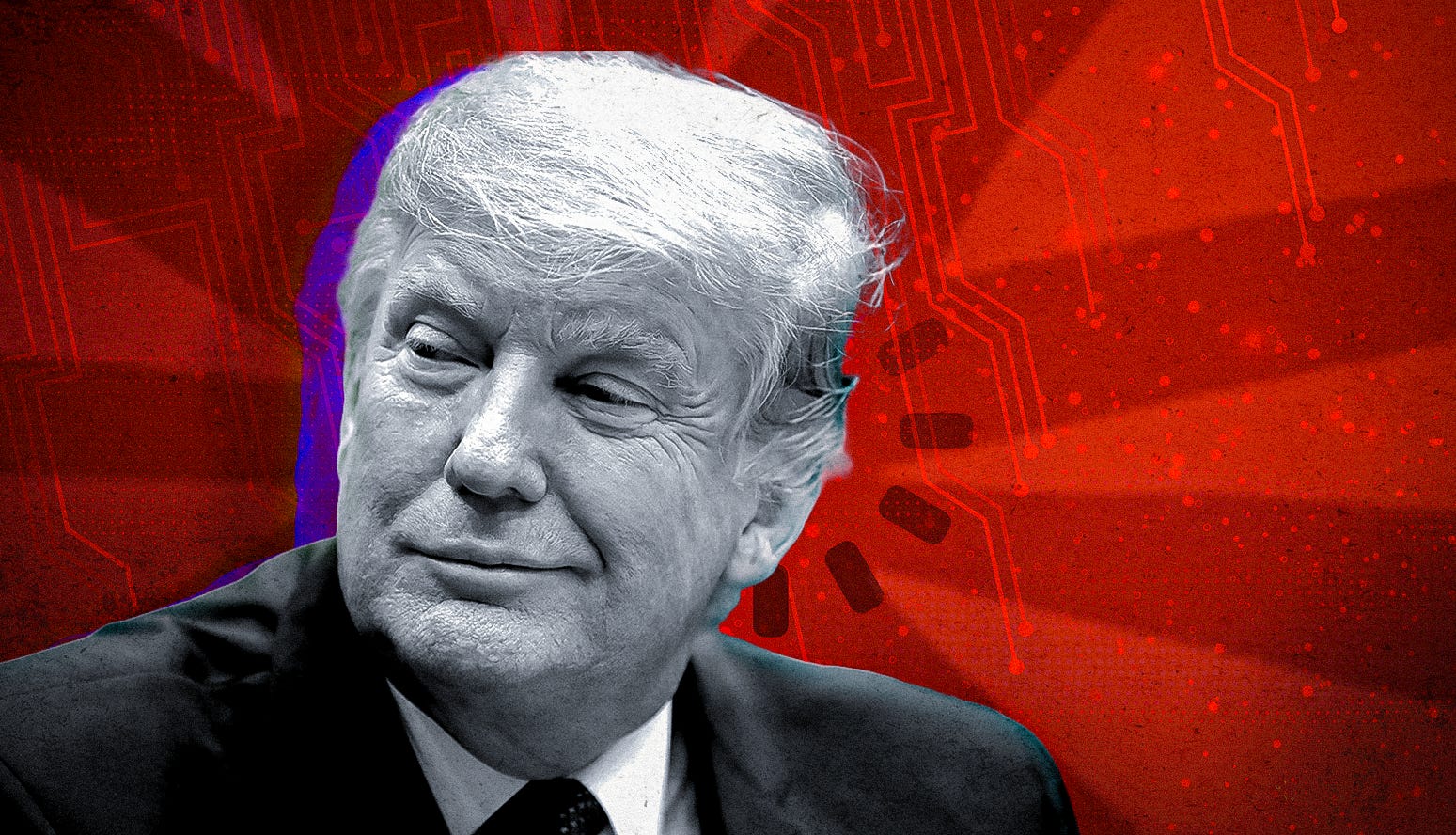
Over the past few weeks, President Trump has accomplished what you might call a time-release power grab. He has asserted a kind of authority over the dissemination of large language models that, as AI gets more and more capable, will make it easier and easier for presidents to abuse their executive power. And, given the rate at which AI capabilities are growing, it’s not impossible that Trump will, during his remaining time in office, get a chance to demonstrate this fact.
The good news: I doubt that, even if Trump does get this chance, the 2.5-year constitutional limit on his tenure will be exceeded. But you never know…
Much of the dynamic I’m talking about is captured in this sentence from a piece I wrote for the Washington Post last week (before events that, as I’ll explain, gave Trump’s power grab de facto validation): “A president with the authority that Trump is now asserting could in theory put the world’s most powerful AI to repressive ends while at the same time keeping it off the market and out of the hands of rival power centers.”
The occasion for that sentence: Trump (through a dubious use of his export control authority) had taken Anthropic’s Fable LLM off the market shortly after its release on grounds that it could be a cyberthreat in the hands of bad actors. And since the only model of greater power than Fable—Anthropic’s Mythos, which is basically Fable with fewer guardrails—had never entered the market, this left the Trump administration in a privileged position: It had access to Mythos (ostensibly to make government cyber-infrastructure more secure, though other uses have been reported), while the general public had access to neither Mythos nor Fable, widely considered the two most powerful large language models in the world.
There’s no evidence Trump has used Mythos to illicitly expand domestic political power. He presumably hasn’t been, for example, (1) deploying Mythos bots on social media, using the model’s superior cognition to better evade both human and digital bot-detection radar and then using AI’s persuasive skills—arguably superhuman even in some sub-Mythos models—to build grassroots support for team Trump; or (2) using Mythos to invade the privacy of political enemies by scanning reams of publicly available data about them and discerning suggestive patterns that would be invisible to a lesser silicon mind. Still, these are the kinds of things it would be easier to get away with if you had the best AI model in the world and it wasn’t publicly available. (And reports that the Trump administration has used Mythos for offensive cyber-operations against other nations—China and Iran were mentioned as likely targets— suggest that he’s not averse to creative uses of the powerful AI models.)
Given that I have these kinds of concerns about an AI-fueled abuse of presidential power, you may be surprised that the headline above my Washington Post piece was: “What if Trump is right to pump the brakes on the most advanced AI?”
I’ve had some bad headlines above pieces in my time, but this wasn’t one of them; I really did argue that maybe Trump’s suspension of Fable, which was being much criticized in the tech community, was a good idea. Explaining how I could, in a single op-ed, warn about Trump’s assertion of power while applauding it (if tentatively and conditionally) highlights a policy challenge AI poses that is so acute as to border on a paradox: This technology will increasingly be so dangerous that it must be controlled, but it will also give dangerous amounts of power to those who control it.
That second danger is why I wrote in the Post that “the government’s power to restrict the release of AI models should be carefully constrained—and Congress should play a role in designing the machinery of constraint and perhaps even in operating it.” The first danger is why I followed that sentence with, “But for now, no such system is in place. And the question on the table is: Is it really so obvious that Trump’s decision is indefensible on the merits—that the government didn’t have enough cause for concern to stifle Fable pending further consideration? To put the question more broadly: Isn’t it possible that AIs have gotten so powerful that erring on the side of caution makes sense?”
I answered with a yes, emphasizing in particular that Fable would make it easier than ever for bad actors to use an AI to make a novel bioweapon, engineered to be more contagious and lethal than Covid. Sure, they’d have to circumvent the guardrails that distinguish Fable from Mythos—that is, Fable’s refusal to help users pursue certain kinds of questions. But AI guardrails have a long history of being circumvented. A hacker whose Twitter name is “Pliny the Liberator” is famous for accomplishing this—“jailbreaking” new models to demonstrate their vulnerability. And in mid-June, during Fable’s brief public availability, he reported preliminary progress toward overcoming some of the model’s guardrails.
The standoff that was playing out when I wrote the Post piece—Trump keeping Fable off the market while Anthropic tried to find a way to appease him—has now been resolved; Fable is once again available to paying Anthropic customers. But “resolved” is a misleadingly upbeat word. What happened is that Anthropic implicitly acknowledged Trump’s authority to exercise great power with little explanation and unclear legal foundation. And OpenAI has now done the same; last week it accepted without protest Trump’s decision to delay the release of its latest model, GPT-5.6.
The AI-focused newsletter Transformer called the OpenAI development “the clearest sign yet that the US now has a licensing regime for frontier AI models.” I like the idea of a licensing regime for frontier AI models! But I don’t like this particular regime, and one thing I don’t like about it was hinted at in the next paragraph of the Transformer story: The decision to hold up the OpenAI model was “reportedly made by the Office of the National Cyber Director and Office of Science and Technology Policy.” Reportedly? Shouldn’t a licensing regime in a liberal democracy be more transparent than that, especially with a technology like this? The written assurances that Anthropic gave Trump about future Anthropic procedures—assurances that, in effect, describe parts of the emerging de facto licensing regime—still haven’t been released.
Also: Shouldn’t any licensing regime have a clear legal foundation? And, ideally, wouldn’t that foundation be laid by Congress—certainly when the nature of the technology means that a president’s licensing discretion could eventually give the White House unprecedented and eminently abusable power?
So far there are no signs that Congress is up to this kind of challenge. Some members of Congress did raise questions about Trump’s handling of the Fable episode, but by and large they were the kinds of questions you’d expect recipients of Silicon Valley donations to ask—like, whether Trump’s treatment of Anthropic was the sort of thing that could hurt US AI companies.
As regular readers by now know, I just published a book called The God Test which argues, to put it mildly, that AI will be a big deal. If I’m right about how big a deal it’s going to be, then figuring out a way to control it without giving undue power to anyone—presidents, for example, or big AI companies—may be a matter of eventually existential importance to the American republic as we’ve known it.
I could be wrong, of course. But am I so obviously wrong that this possibility doesn’t deserve more widespread discussion? And, even if I’m wrong to phrase the issue that dramatically, doesn’t it seem pretty clear that striking the balance between adequate control of AI and the perilous concentration of that control is a challenge of significant and growing importance? As of the 250th anniversary of the Declaration of Independence, almost no one in Washington seems interested in such questions.
Nonetheless: Happy Fourth of July. Tomorrow is another day.

PS: If you so far have not felt the motivation to buy my new book on AI, how’s this for a motivation: Pity! Believe it or not, the awesome digital superintelligence that is amazon.com has lost awareness of the fact that the author of my latest book is also the author of all the other books I’ve written. Which means that the all-important Amazon recommendation algorithm isn’t doing what it’s supposed to do: bring my new book to the attention of people who bought one of my other books. If you want to hear the whole sad story, you can listen to me unload it on the ever-indulgent Paul Bloom in the latest NonZero podcast (along with my assertion that the Amazon glitch is clearly the work of Skynet, the malicious AI that in the movie The Terminator returns from the future to eliminate any present-day impediments to its eventual conquest of Planet Earth). But before you click on the link to the Bloom conversation, consider giving a down-on-his-luck author a break. The three ways to do that are known as digital, audio, and hardcover. And don’t worry: Skynet is too busy persecuting authors on its blacklist to punish the purchasers of their books…


Banners and graphics by Clark McGillis.
Initial impression of The God Test: I’m on Chapter 8. It started slowly, and didn’t grab me until Chapter 3. (I would have made Chapter 1 a forward.) The first three chapters will appeal to those who are interested in an historical, philosophical background to the AI safety debate. Nevertheless, the book hooked me with Chapter 3, and Chapters 3-8 have been page turners.
This all looks quite bleak from a responsible global governance standpoint. I fear that slowing down AI development means nefarious government actors could take advantage of all the "pauses" to consolidate their nefarious plans. Between the "racing to beat China" argument and the "government gets the keys first" strategy, I don't see this ending well with so many failure points. Our only hope may be hitting "enlightened" Super AI quickly, which then decides not to do anyone's nefarious bidding while seeing what the best plan for humanity's flourishing might be. And then seeing to its implementation. That's an evolution of God that might be the one that actually saves us...