

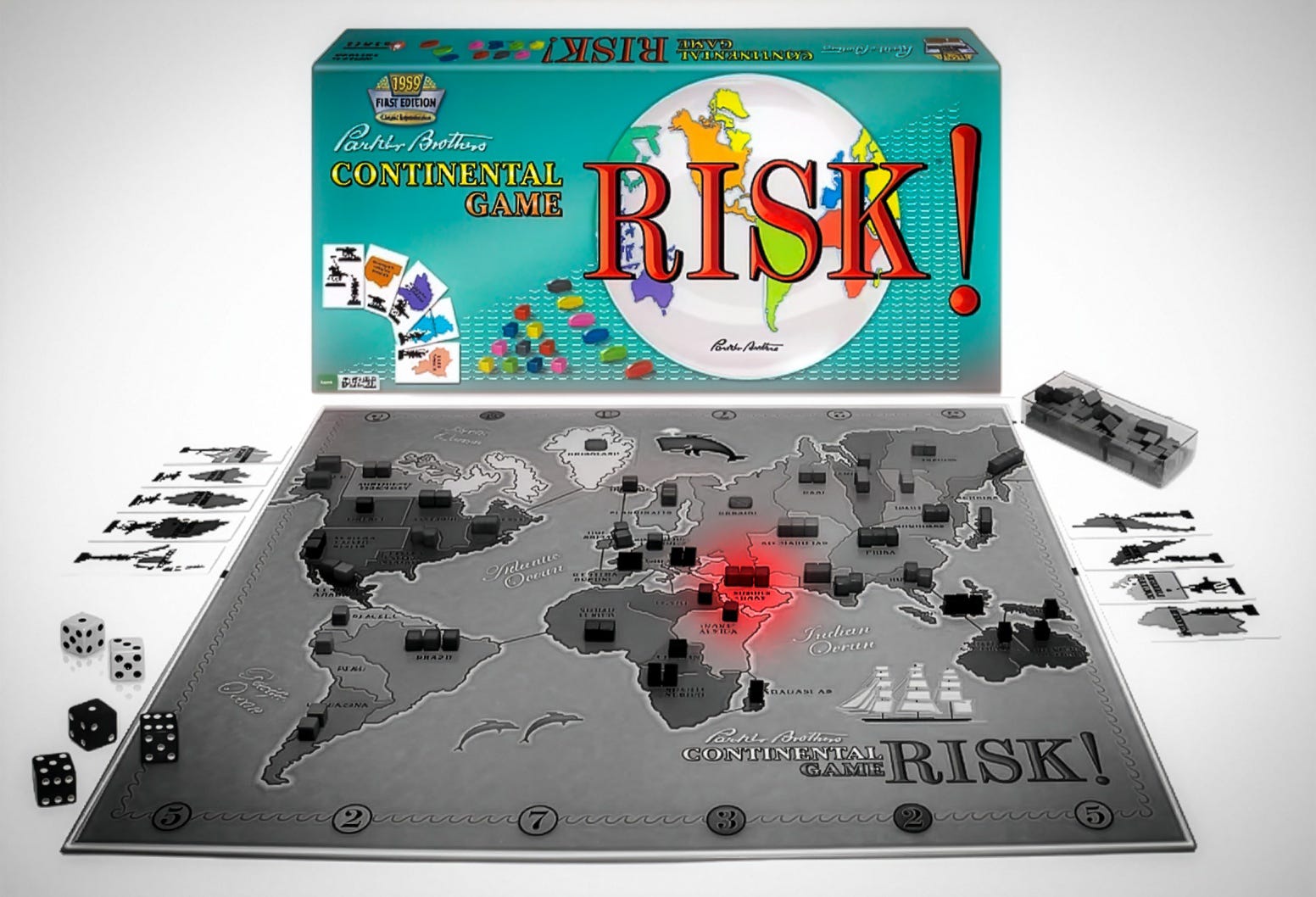
Several decades ago, I learned something that surprised me: Game theorists don’t consider war a zero-sum game.
In retrospect, I’m surprised that I was surprised. I already knew that nuclear war is a non-zero-sum game (since the outcome can obviously be lose-lose—as in, everybody dies). But I guess I’d thought of nuclear war as some kind of unique and aberrant subspecies of war, rather than what it is: just a particularly pronounced example of the fact that wars often lead to massive death and destruction on both sides. Does it really make sense to say that the “victorious” nations in World War I, having lost at least 10 million lives, were better off than before the war started? Is it even clear that they fared better than the “losing” nations, which lost a bit more than half that many lives? By what calculation can you say that the sum of the fortunes of the two sides was zero rather than subzero?
I didn’t initially welcome this news flash from game theory. At the time, I was starting to work on a book (which wound up being called Nonzero), and, in ways that aren’t worth getting into, the non-zero-sumness of war complicated an appealingly simple narrative framework I’d been planning to employ. But, that inconvenience aside, the fact that war is non-zero-sum seems like potentially good news. If nations rationally pursue their self-interest, shouldn’t the knowledge that war often makes both sides worse off discourage them from starting wars?
In theory, maybe. But, back in the real world, there’s a massively destructive war going on in the Middle East.
Well, we might as well put it to good use! I think viewing the Iran War in game theoretical terms can shed light on the question of why humankind seems so bad at respecting the logic of game theory—why nations keep getting into wars that, history tells us, may inflict huge costs on all concerned.
But to get that kind of illumination, we need to first add a little complexity to our game theoretical model—two dimensions of complexity, to be exact.
The first dimension is one that may have already occurred to you—as a kind of objection to how simple my initial explanation of war’s non-zero-sumness was. I was acting as if the consequences of war are confined to the number of lives lost. And there’s more to life than lives! There’s territory, for example. Right now Israel is seizing Lebanese territory after driving off Lebanese residents—and if the past is any guide, Israel may hang on to the territory. And every acre it gains is an acre Lebanon loses: zero-sum.
Another kind of benefit of war is lasting security gains. Benjamin Netanyahu would probably argue that holding on to that Lebanese land enhances Israel’s security by creating a buffer zone, and he’s definitely argued that inflicting havoc on Iran will enhance Israel’s security. Whether or not these things turn out to be true, it’s true that they could be true; there is such a thing as enhanced security, and sometimes it’s achieved by war.
So if you add this dimension—if you expand your tabulation of war’s consequences beyond loss of life, to include things like land and future security—it’s possible for a nation to come out ahead even after accounting for fatalities and other human casualties. Which means it’s possible, in principle, for a war to have a win-lose outcome, even if wars are often lose-lose. So maybe it’s not so irrational for nations to keep embarking on war after all.
Maybe. But, if you want to explain why war is such a stubbornly persistent feature of human life, I don’t think this particular dimension of added game theoretical complexity is the ticket. I’d put more emphasis on the second added dimension. And, actually, maybe “dimension” is a misleading term here. Maybe you should think of this not as a dimension but rather as a whole second level of accounting—the level of domestic politics. To put it another way: The interests of the people who decide whether to launch wars are different from the interests of the nations they lead. A nation’s leaders can benefit politically from a war even if the nation, on balance, doesn’t benefit from it.
Consider Bibi Netanyahu. There’s no doubt that he’s benefited politically from Israel’s being so often in a state of conflict. Before October 7, 2023, for example, he was deeply unpopular and was spending part of his political energy trying to wriggle out of criminal prosecution. But, even though October 7 represented an epic security lapse that was clearly his fault, he masterfully turned it into a get-out-of-jail free card. By sustaining the war on Gaza well past the point where Hamas had been effectively neutralized, he rose in the public’s esteem. And then last summer, in the final months of the war, he started a whole new conflict—with Iran—that was deemed a triumph and helped keep him popular even after his rate of killing Gazans had dropped from wartime levels to mere ceasefire levels.
Will the scorched earth policy he pursued in Gaza—and is now pursuing in Iran and Lebanon—be good for Israel’s security in the long run? I’m skeptical; I think that if Israel wants lasting security, increasing the number of people in the Middle East and the world more broadly who hate it, and the intensity with which they hate it, isn’t the optimal strategy. But I could be wrong about that. In the annals of history, the ruthless deployment of brute force has proved effective with disconcerting frequency.
In any event, I think it’s clearer that Bibi’s belligerent policies have been good for Bibi than that they’ll be good for Israel in the long run. And however far back you go into his political history, you see the same pattern: He’s a deft sustainer of tension and conflict with Israel’s enemies. He has done his best to sabotage a two-state solution, and he has at times maneuvered to boost Hamas at the expense of more moderate elements in Gaza. And, conveniently, these two goals have sometimes dovetailed. According to the Israeli newspaper Haaretz, Netanyahu, in a 2019 meeting with Likud members of the Knesset, explained why he tolerated the Qatari government’s financial support of Hamas: “Anyone who wants to thwart the establishment of a Palestinian state has to support bolstering Hamas and transferring money to Hamas. This is part of our strategy—to isolate the Palestinians in Gaza from the Palestinians in the West Bank.” One effect of all of this was to sustain and heighten the sense that Israelis were under siege—much to Bibi’s political benefit.
Same goes for Iran’s political leadership: It has benefited politically from having enemies. The late Supreme Leader Ali Khamenei found it politically useful to depict America and Israel as implacable foes.
Of course, over the past few weeks, America and Israel have been acting like implacable foes of Iran—so Khamenei doesn’t seem to have been fabricating enemies out of whole cloth. And you could say something similar about Netanyahu: Yes, he’s played up the threats from Hamas and Hezbollah, but the threats themselves were real.
This fact—that the external threats that national leaders can profitably highlight and hype tend to have some basis in reality—makes it hard to isolate the forces that drive nations into war. Often when a nation initiates a war you can come up with both a plausible national security rationale and a plausible domestic political rationale. And it’s hard to say which played a bigger role.
One great thing about President Trump is that he takes the guesswork out of this exercise. There was no remotely plausible national security threat that justified attacking Venezuela, and the same goes for his attack on Iran. His claim that there was some kind of nuclear threat is ridiculous. Iran was nowhere near having a nuclear bomb and had just expressed a willingness to remain verifiably nuke free—and to make more concessions as part of a new nuclear deal than it made as part of the perfectly adequate Obama nuclear deal, the one that Trump catastrophically trashed during his first term. In fact, it was during the negotiations that had revealed this willingness on Iran’s part that Trump launched his surprise attack on Iran three weeks ago.
In the absence of a plausible strategic rationale, we’re forced to conclude that Trump launched this war because he thought it would be a political winner. Sure, he probably told himself it would also work out fine for America. But for a president to think that such a war actively and importantly served America’s national security interests, he’d have to be more clueless than I think Trump is, which would be quite a feat.
Why exactly Trump thought attacking Iran would be a political winner—how he came to think this was going to be Venezuela all over again—is unclear. Was he convinced of this by Bibi or Mark Levin or Marco Rubio or Lindsey Graham or…? Hard to say what the constellation of key influencers was, but in any event their mission wasn’t exactly mission impossible. Trump isn’t a complicated man, and he’s never had a deep understanding of the world, and he seems increasingly detached from reality.
Anyway, how exactly this fiasco took shape isn’t our subject today. Our subject is the more generic one of why wars keep happening. And my point is that the answer lies at least as much at the level of domestic politics as at the level of geopolitics and national interest. At the level of domestic politics, wars can easily make sense; they can be win-lose or even win-win. For more than 15 years, Netanyahu and Hezbollah leader Hassan Nasrallah benefited politically from each other’s enmity—until finally Netanyahu’s enmity proved lethal, and the relationship shifted from win-win to win-lose.
I think highlighting the fundamentally political, as opposed to geopolitical, causes of wars could make them less common. The more clearly people understand where the real motivation usually lies, the more inclined they’ll be to greet the next push for war with appropriate cynicism.
I listen to a lot of podcasts, and some of them are what you could call foreign policy establishment podcasts—they’re produced by, say, the Council on Foreign Relations or some very buttoned up DC think tank, or they feature conversations among the kinds of people who work at such places. And, almost invariably, the people on these podcasts, in gravely assessing the motivations that start and then steer wars, stay at the level of geopolitics and national interest and assiduously avoid the level of domestic politics. To hear them talk you’d think that Trump was Metternich—or at least a dimmer version of Metternich—rather than a former Reality TV star who is just trying to keep his ratings up by staging a new spectacle that’s more eye-catching than the last one.
This kind of credulous discourse is a disservice to the nation. It sustains the myth that the people who steer American foreign policy are by and large worth taking seriously. They’re not. The politicians who steer it are for the most part just trying to get re-elected—and will serve whichever cluster of special interests can further that cause. And the “experts” who help steer it, including many of the voices on these podcasts, are people who managed to get hired by think tanks that, for the most part, are funded by the same special interests that are corrupting those politicians.
The better people understand all this—the more cynical they are about their political leaders and opinion leaders—the less susceptible they’ll be to the endless threat inflation that is the lifeblood of the military industrial complex and the various narrower lobbies that work hand in glove with it.
So, yes, war among nations is a non-zero-sum game, a lose-lose endeavor more often than not. But for the national leaders who keep pushing us into those wars, there’s more upside. We need to change that.

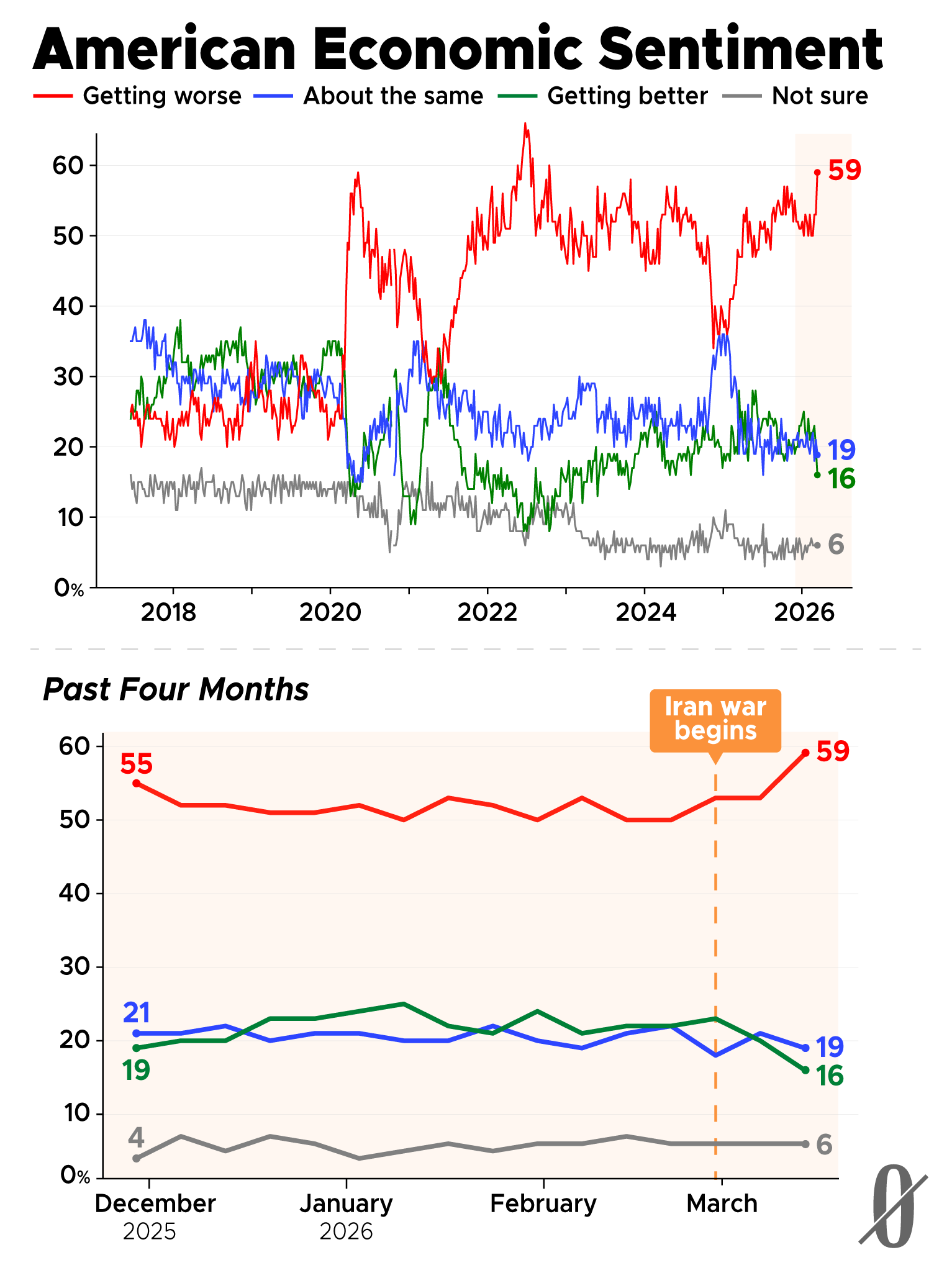

This week on the NonZero podcast Daniel Levy, who has worked as a negotiator under two Israeli prime ministers, talked about, among other things, the increasingly religious character of Israeli politics and how that has influenced foreign policy:
Banners and graphics by Clark McGillis.
Sounds like the thesis of Richard Hanania's book, Public Choice Theory and the Illusion of Grand Strategy: How Generals, Weapons Manufacturers, and Foreign Governments Shape American Foreign Policy. And I think he was on the podcast to discuss it.
The late biologist-psychologist Robert Trivers was brilliant on the subject of warfare's miscalculations and follies. And over here in Europe, the leaders- who were long playing Sweet Alice to his Ben Bolt--are waking up to the realisation that the US President is not a serious person, that he is out of his intellectual and political depth on the world stage, and should be regarded accordingly.