

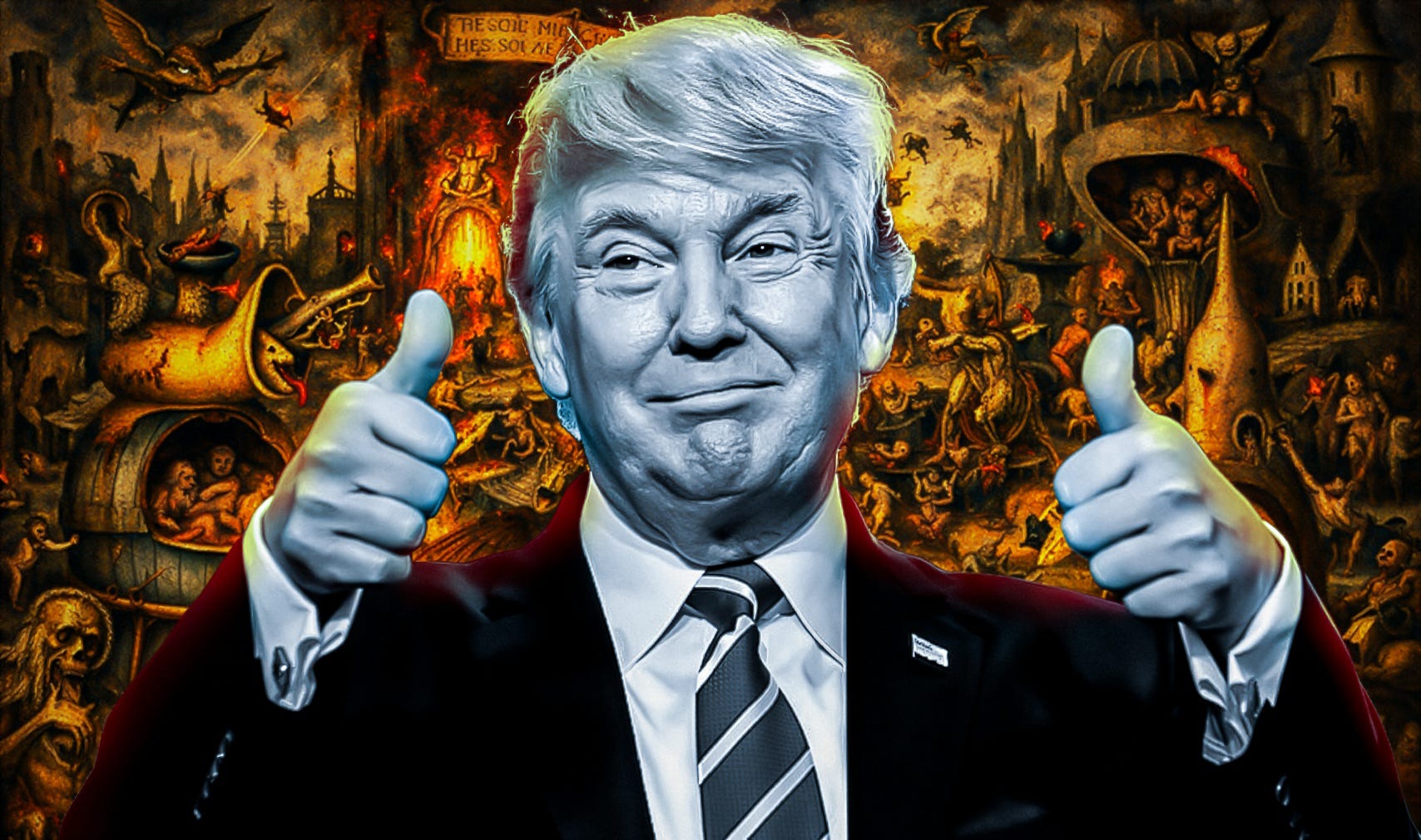
There is good news on the Trump front—news that reduces the chances that America will descend into an authoritarian hellscape (or, depending on your view of the current moment, descend further into one).
Three weeks ago, in a piece titled “Some Useful Trump-Hitler Comparisons,” I envisioned “a path by which America could get closer to Hitler-level authoritarianism.” I wrote:
Incidents like the Renee Good killing can trigger mass reactions that Trump deems unruly enough to warrant countermeasures—Army deployments or National Guard deployments or additional ICE agents or maybe even loosened rules of engagement… Those countermeasures can lead to more mass reactions, more countermeasures, and so on. The danger of Trump, on the domestic front, isn’t that he’s Hitler or aspires to become Hitler, but that he has enough in common with Hitler to set in motion a very negative kind of positive-feedback cycle and then happily do what he can to sustain it, making good use, at key moments, of his contempt for the principles of liberal democracy.
This is one of those rare cases where I wasn’t hoping that future developments would prove me prescient. But for a while it seemed they might. The day after my piece was posted, the Department of Homeland Security disclosed that “hundreds more” federal agents would be sent to Minneapolis. And three days after that, Trump said he might invoke the Insurrection Act and send soldiers to Minneapolis. Shortly thereafter I saw a picture of someone who was either a protester or a counter-protester carrying a gun and thought, “This kind of thing could lead to trouble.” And a few days later that kind of thing did lead to trouble, though not in the way I’d expected. A protester with a holstered gun—Alex Pretti—was killed by federal agents after being disarmed.
At this point there was reason to think the positive feedback cycle would continue—that Trump would again escalate, sending still more federal agents to Minneapolis or maybe now follow through on his threat to send troops. After all, protesters were starting to carry guns! If you back down in the face of that kind of threat, it will only grow!
But then I heard my favorite sound: the sound of Trump keeping his mouth shut.
OK, that’s an exaggeration. Trump never keeps his mouth shut. But he didn’t do what he’d done after the Renee Good killing: Sing in tune with hare-brained Homeland Security Secretary Kristi Noem and hyper-creepy White House adviser Stephen Miller. Both of them, after the Pretti killing, trotted out the “domestic terrorist” refrain that had been applied to Renee Good, and Miller added that Pretti had “tried to assassinate federal law enforcement.” Trump, though, didn’t rush to judgment the way he had after the Good killing and, after some reflection, said that he didn’t think Pretti had intended to assassinate anyone.
Plus: Greg Bovino—who had headed the immigration raids in Los Angeles and Chicago and now Minneapolis, and had called the agents who killed Pretti “victims”—was relieved of duty, replaced by “border czar” Tom Homan, who promptly announced that he was planning a “drawdown” of ICE and Border Patrol agents from Minneapolis. And the end of the week brought this news: The investigation into the shooting wouldn’t be just a pro-forma internal investigation; in addition to the DHS investigation, there would also be a civil rights investigation of the shooting within the Justice Department.
Now, granted, this is all pretty cosmetic. So far there’s been no drawdown—and the New York Times reports that this week federal agents were quietly given broader power to arrest people without warrants. And I’m not getting my hopes up about an investigation conducted under the supervision of FBI head Kash Patel (whose nonprofit, the Kash Foundation, was set up to help pay the legal fees of January 6 Capitol Hill rioters) and within a Justice Department run by Trump loyalist Pam Bondi.
Still, it matters that Trump felt compelled to attend to the cosmetics. Cosmetics can have consequences. In this case, attending to the cosmetics meant that Trump didn’t escalate in the way that my positive feedback scenario assumed.
It’s not hard to explain Trump’s sudden turn toward moderation. His approval rating had taken a hit after the Renee Good killing, and the early signs were that the Alex Pretti killing wasn’t going to play well either. Some Republicans in Congress raised questions about the shooting—and not just the handful of moderates who occasionally give Trump trouble. Even Ted Cruz called for an investigation and advised the administration to tone down its rhetoric.
In a way this is a version of what, in the course of Trump’s tariff brinksmanship, came to be called TACO—Trump Always Chickens Out. He sends hundreds more agents into Minneapolis and threatens to send troops, and then all of a sudden he’s talking about withdrawing agents from Minneapolis. But TACO is like Trump: It should be taken seriously but not literally; Trump doesn’t always chicken out. He chickens out when he faces real blowback. If China hadn’t stood up to him by credibly threatening retaliation, China would be facing higher US tariffs. Trump may talk tough and then fold, but only in the face of real toughness.
Unfortunately, this doesn’t mean that all it will take to get Trump to de-escalate on the domestic front is toughness per se—the kind of fierce and determined resistance that protesters in Minneapolis have shown. To be sure, that resistance matters; it has been a pre-requisite for Trump’s recalibration. But there were distinctive things about both the Renee Good and Alex Pretti killings that made them work against Trump politically.
There was the video of Renee Good saying to ICE agent Jonathon Ross, “I’m not mad at you” less than a minute before he shot her three times and said, “Fucking bitch!” And the fact that Alex Petti was armed had the ironic effect of making him a more sympathetic character in the eyes of a key Republican constituency, Second Amendment crusaders. And the fact that he was shot in the back—and shot ten times—made things only worse for Kristi Noem and Stephen Miller.
No one can guarantee that contingencies like this will continue to work against Noem and Miller. You can imagine a future killing involving an armed protester that would have different political consequences (if, for example, the protester, unlike Pretti, does use the gun and even kills people).
So how exactly the resistance is conducted will matter. And even if it’s conducted with wisdom and discipline, contingency will play a big role. There’s no telling how this whole thing will play out.
Still, as long as we’re trying to focus on good news, I’ll close on these two notes:
1) Though the grassroots blowback was shaped by the particulars of these tragic events, and next time the particulars could be different, some of the blowback also, I think reflected something basic and enduring: Americans don’t by and large want to see their country dissolve into chaos; and most Americans don’t like to see masked men with guns roaming the streets and treating citizens like enemy combatants.
2) Though Trump was no doubt influenced by the pushback he got from prominent Republicans in Congress and elsewhere, I think the critical blowback came ultimately from the grassroots level. Ted Cruz never has been and never will be a profile in courage; in giving Trump some pushback, he was to a large extent channeling the views of constituents.
In that sense, this was democracy at work. Popular feedback mattered. And nothing stops a positive feedback cycle like negative feedback.


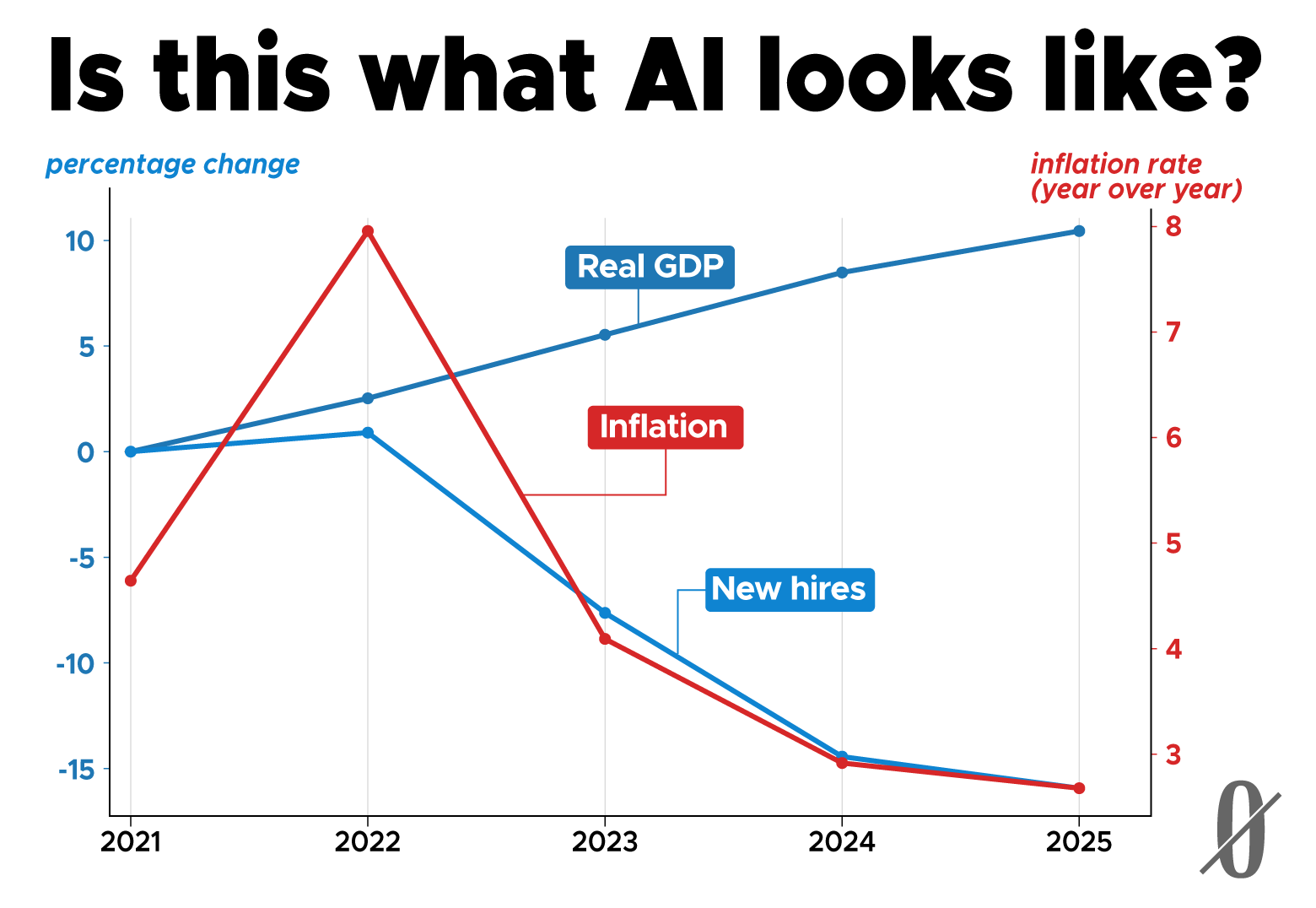
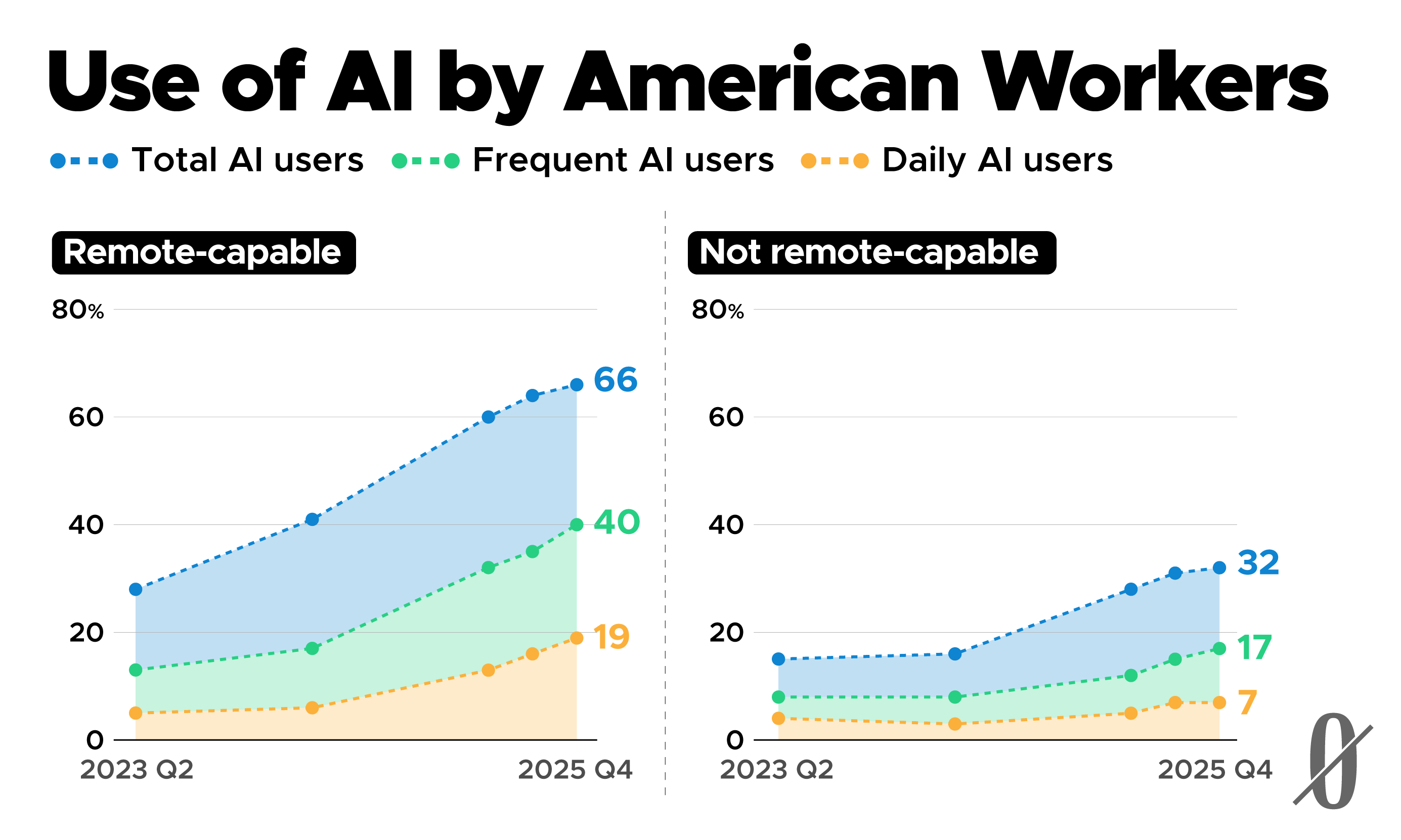
At some point, they tell us, AI will boost productivity. Is that already happening? Well, if so, that could help explain something that has surprised many economists: Inflation has stayed low—indeed has dropped slightly—even as Trump’s tariffs have taken effect. The workplace use of AI could also explain the low rate of new hires, especially given that large language models are said to do “intern-level work” in many contexts. You’d also expect AI-driven productivity growth to sustain robust GDP growth even as inflation and new hires stay low. In short, an AI-influenced economy should look like what you see above. Granted, AI can’t be the entire explanation. ChatGPT wasn’t seeing much practical use until well into 2023 (GPT-4 came out that spring), yet 2023 shows sharp changes in both inflation and new hires. Still, historically, these three things—low inflation, low hiring, and robust GDP growth—have rarely been reconciled for very long. So if you’re trying to figure out whether AI is having much impact in the coming months and years, keep an eye on these lines. And also on surveys like the one below. (The survey found that 46 percent of all workers surveyed report using AI to at least some extent.)
Banners and graphics by Clark McGillis.
We took it to the street yesterday and even though it was a very visual rally over a major highway we were struck by the music played. Fuck this, fuck that. We had hopped for not lowering the cause to this level. There were no ICE around but we wondered what level we would be in then. We are against violence but in our way try to instigate it our self. Then we observed a young couple screaming the song to their young boy to get him into the spirit of the song. It really makes you think why we get into wars. Personally we wish that protesting could be done with less escalation of anger. Good luck on that.
Bob, this is completely unrelated, but you should search yourself in the epstein files: https://www.justice.gov/epstein
lawrence krauss mentions you by name lol!
edit: Paul Bloom's friend, Steven Pinker, seems to have been very cozy with epstein! Nice emails between them even after Epstein's conviction. What an amazing moral compass Pinker has -- must explain his perspicacity w.r.t. israel/palestine.