


In 2018 I wrote a piece for the Intercept called “How the New York Times Is Making War with Iran More Likely.” Last week I wrote a piece in NZN about the conflict between Pentagon Chief Pete Hegseth and Anthropic CEO Dario Amodei called “Dario Amodei is not the hero we need.” I know these two stories don’t sound related, but bear with me.
And as long as I’m laying out strands that I promise to tie together by the end of this piece: (1) The Washington Post reported this week that Anthropic’s Claude AI has helped select targets hit by the US in the Iran war; and (2) Reuters reported that, according to a preliminary investigation, it was the US, not Israel, whose air strikes hit an elementary school on the first day of the war, killing more than 100 Iranian girls.
My Intercept piece made two main points. One was about a generic cause of war—an unfortunate psychological tendency that has long helped keep the world mired in conflict. The other was about a specific contributor to US-Iranian hostility—a bias in US media coverage that does its damage, in part, by energizing that unfortunate psychological tendency. Neither of these problems—warped human cognition or warped US media coverage—has been remedied since I wrote that piece, and that’s one reason we’re at war with Iran now.
The unfortunate psychological tendency is a distortion that tends to afflict the perception of adversaries: We read offensive intent into ambiguous actions, including actions that have largely defensive purposes. This tendency famously helped start World War I. Each side read offensive intent into military preparations that were defensive, and each side was led by this misperception to counter with defensive preparations—preparations that were in turn misread as offensive… and so on. Years before war broke out, President Theodore Roosevelt observed, “It is as funny a case as I have ever seen of mutual distrust and fear bringing two peoples to the verge of war.”
In the case of Iran, the exaggerated perception of offensive intent makes it easier for hawks to argue—as President Trump has argued in justifying this war—that Iran must be attacked before it does the attacking. One reason that perception is so exaggerated in America, I argued in the Intercept piece, is that US media tends to view Iran from Israel’s point of view—in other words, view it via the distorted perception that is unsurprising in an Iranian adversary such as Israel.
My piece was largely a dissection of a single New York Times piece, co-authored by Ben Hubbard, Isabel Kershner, and Anne Barnard. I wrote:
The headline, in the top-righthand corner of the front page, read, “Iran Building Up Militias in Syria to Menace Israel.” Just about any expert on Iran would agree that, strictly speaking, this headline is accurate. However, a number of experts would add something that these three reporters failed to add: From Iran’s point of view, the purpose of menacing Israel may be to prevent war; having the capacity to inflict unacceptable damage on Jerusalem and Tel Aviv can be a way of keeping both Israel and the US from attacking Iran.
As I noted, this omission wasn’t shocking, given the two analysts the Times piece had most prominently relied on. One was a fellow at the Foundation for Defense of Democracies, a fiercely pro-Israel and anti-Iran think tank that had gotten funding from ardent Israel backers like Sheldon Adelson and Home Depot co-founder Bernard Marcus. The other analyst was an alumnus of FDD.
In the Intercept piece, I quoted an Iran expert more eminent than the people quoted by the Times—Vali Nasr of the Johns Hopkins School of Advanced International Studies, who, as it happened, had just written a relevant piece for Foreign Affairs. I wrote:
Nasr writes that “the Israeli and US militaries pose clear and present dangers to Iran.” He explains how this threat, along with hostile Arab neighbors and other perceived threats, has given rise to Iran’s policy of “forward defense.” He writes: “Although Iran’s rivals see the strategy of supporting nonstate military groups”—in Syria and Lebanon—“as an effort to export the revolution, the calculation behind it is utterly conventional.” Iran’s foreign policy, Nasr explains, is driven by national interest more than revolutionary fervor and “is far more pragmatic than many in the West comprehend.”
My piece also listed various reasons Iran had for fearing Israel or the US—many of them unknown to the average American, such as America’s support for Iraq during the Iran-Iraq war of the 1980s, which killed hundreds of thousands of Iranians. I wrote:
The Times piece tells us that Israel and the US “fear Iran’s growing influence,” that Israel “fears that it could face a threat” from Iranian proxies in Syria, that “many Israelis” sense “danger,” and that Iran’s behavior “worries Israel.” All true. But there’s no mention of Iranian “fears” or “worries” or perceived “danger.” There’s also no mention of what, from an Iranian perspective, is a glaring asymmetry: Iranians and Iranian proxies in Syria are there with the permission of Syria’s government. But when Israeli jets routinely enter Syrian airspace to bomb those proxies, Israel doesn’t have the government’s permission and so is violating international law.
My piece got some attention. For example, Anti-Defamation League president Jonathan Greenblatt honored me with a seven-tweet thread that denounced the piece as “illogical at best, biased at worst” and lacking in “any perceptible empathy.”
I figured that, with that kind of notoriety, my piece might come to the attention of the New York Times—and maybe even make its reporters more reluctant to quote pro-Israel propagandists as if they were impartial analysts.
No such luck. Less than two weeks ago—days before Trump launched the current war with Iran—the Times ran a piece saying he was considering two options for attack: a limited strike designed to give the US more bargaining leverage in nuclear talks, and a bigger strike aimed at regime decapitation. The piece quoted an Iran expert warning that the limited strike probably wouldn’t work since it’s “not in the supreme leader’s DNA to make concessions on the Iranian nuclear program” (even though the supreme leader had repeatedly made such concessions). This expert was from… the Foundation for Defense of Democracies.
You might think that this whole experience would leave me embittered and cynical, maybe even inclined to launch a tirade about the influence of Israel and pro-Israel groups on American media and American foreign policy—and maybe, while I’m at it, to take a shot at Jonathan Greenblatt and the ADL, which have long used accusations or insinuations of anti-semitism to stigmatize people who undermine the pro-Israel narrative. Wrong! Now that this war has brought complaints like that into the mainstream, I’ll leave it to establishment figures like Obama-aide-turned-podcaster Tommy Vietor to make them.
I, in contrast, will take the high road. My main aim here is not to impugn Israel or the Israel lobby or complain that they’ve had a corrupting influence on US foreign policy. My main aim, rather, is to impugn Israel and the Israel lobby and all the other lobbies that have had a corrupting influence on US foreign policy—and to suggest that, when you think about it, US foreign policy is little more than the sum total of these corrupting influences.
After all, the American voter, as a rule, doesn’t care about foreign policy so long as it doesn’t lead Americans to come home in body bags. Lots of Americans will confidently declare that the Iraq War was a disaster, but the deeply disastrous Libyan intervention is barely remembered, because so few of the resulting corpses were American. In the absence of ongoing voter concern with foreign policy, it is shaped mainly by intensely motivated and well-resourced special interest groups: the Israel lobby, the Cuba lobby, arms makers, and so on.
Consider, for example, Bill Clinton’s decision to expand NATO, a decision that paved the path to the Ukraine War. Pretty much every expert on the Soviet Union opposed this move, some of them vehemently, but Clinton wanted to win the votes of midwesterners of eastern European descent who favored it. Plus, there are benefits to be had by staying in the good graces of defense contractors. The guy who founded the US Committee on NATO, which lobbied for expansion, was an executive at Lockheed-Martin. He later went on to found the Committee for the Liberation of Iraq, which helped lay the groundwork for the liberation of many Iraqis from their earthly tethers and also for the enrichment of Lockheed-Martin.
All of this helps explain why the US has devoted so much time and energy to enterprises that kill or immiserate millions and millions of people—not just the military interventions we stage, but the profuse supplying of weapons (for Israel’s war on Gaza, for example), and the economic strangulation of nations like Cuba and Venezuela and Iran. All of these endeavors had the support of intensely motivated special interest groups. By and large, the deployment of US troops and arms and sanctions—our big, blunt, coercive instruments—have nothing to do with serving America’s actual interests, much less the interests of the world. And they repeatedly—as now in Iran—cover us in moral disgrace.
This is one reason I harp, however ineffectually, on the importance of respecting international law. The machinery for making US foreign policy is so out of control—so wildly misaligned with American interests, the global interest, and morality—that it urgently needs to be constrained by some clear and coherent set of rules. And so long as it’s not constrained by such a thing, we shouldn’t kid ourselves: The US military (and I say this as an Army brat who grew up with a genuine affection for the military and genuine pride in my father’s service during World War II and after) is now mainly an instrument of mayhem and is increasingly a source of global instability.
All of which brings us back to Anthropic, whose Claude large language model is integrated into Maven, software that’s operated by Palantir and used by the Pentagon to identify targets. The Washington Post reports that “as planning for a potential strike in Iran was underway, Maven, powered by Claude, suggested hundreds of targets, issued precise location coordinates, and prioritized those targets according to importance.” Given that the Iranian elementary school was hit on the first day of the war, it seems fairly likely that Claude played a role in the selection of that target and thus in the death of more than 100 young girls—many times more kids than were killed in the worst American school shooting.
This might seem to vindicate Dario Amodei’s refusal to give the Pentagon carte blanche to use Claude in “fully autonomous” weapons systems. But before we give him the Nobel Peace Prize, note two things: (1) This kind of contractual carveout almost certainly wouldn’t have made a difference in this case even if honored. No doubt there was a “human in the kill chain”—someone who, at a minimum, scanned the list of targets generated by Maven and said, “Yep, looks like a list of targets. Let’s do it!” (2) Even if Amodei’s scruples had somehow magically prevented the bombing of that school, Claude would still be an accomplice to mass murder. More than 1,000 Iranian civilians have already been killed in this war—a war that flagrantly violates international law and continues to lack a coherently articulated rationale. Anyone who makes money by aiding endeavors like this has a lot to answer for.
Last week Amodei, in explaining Anthropic’s position on Pentagon contracts, emphasized the company’s overall commitment to national security. He wrote, “I believe deeply in the existential importance of using AI to defend the United States and other democracies, and to defeat our autocratic adversaries.” If Amodei genuinely believes that the US military is devoted to addressing actual “existential” threats to the US, he’s too naive to be entrusted with anything as important as running a big AI company.
Obviously, this indictment applies about equally to OpenAI’s Sam Altman (who gladly swooped in and snatched the Pentagon largesse that Amodei will now be denied) and to Google’s Sundar Pichai and Demis Hassabis and to xAI’s Elon Musk. All the big AI companies are putting their tools at the disposal of the Pentagon to use as it sees fit.
All of these men, if pressed to justify this, would no doubt recite something about the importance of keeping America secure. Maybe somebody should ask them to name a recent US military intervention that had that effect.

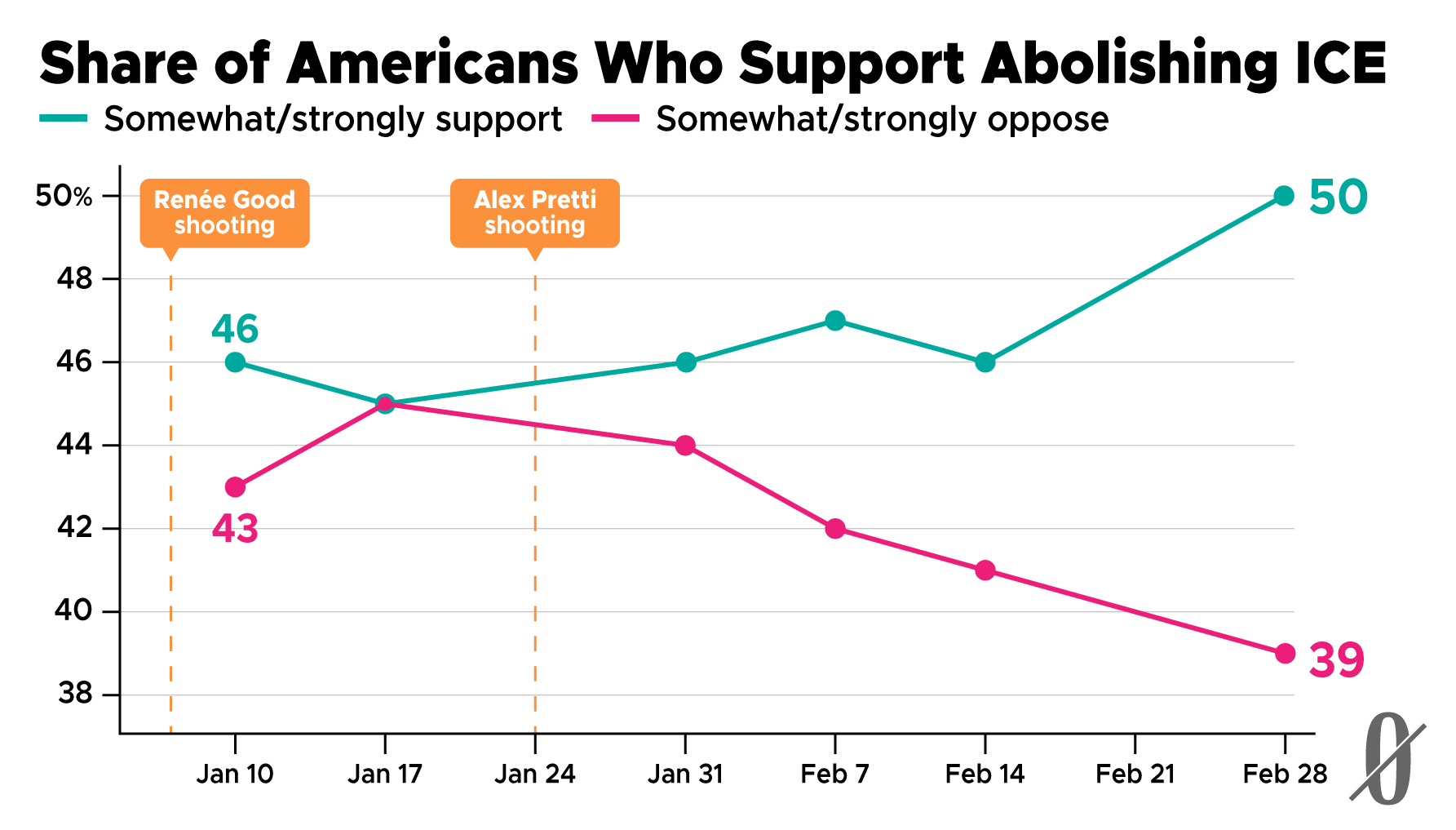
This week saw the resignation of Kristi Noem as Secretary of Homeland Security, the department that oversees ICE and border patrol. The precipitating event came during her testimony at a congressional hearing, but the above graphs suggests that for some time now the political winds hadn’t been blowing in her favor.

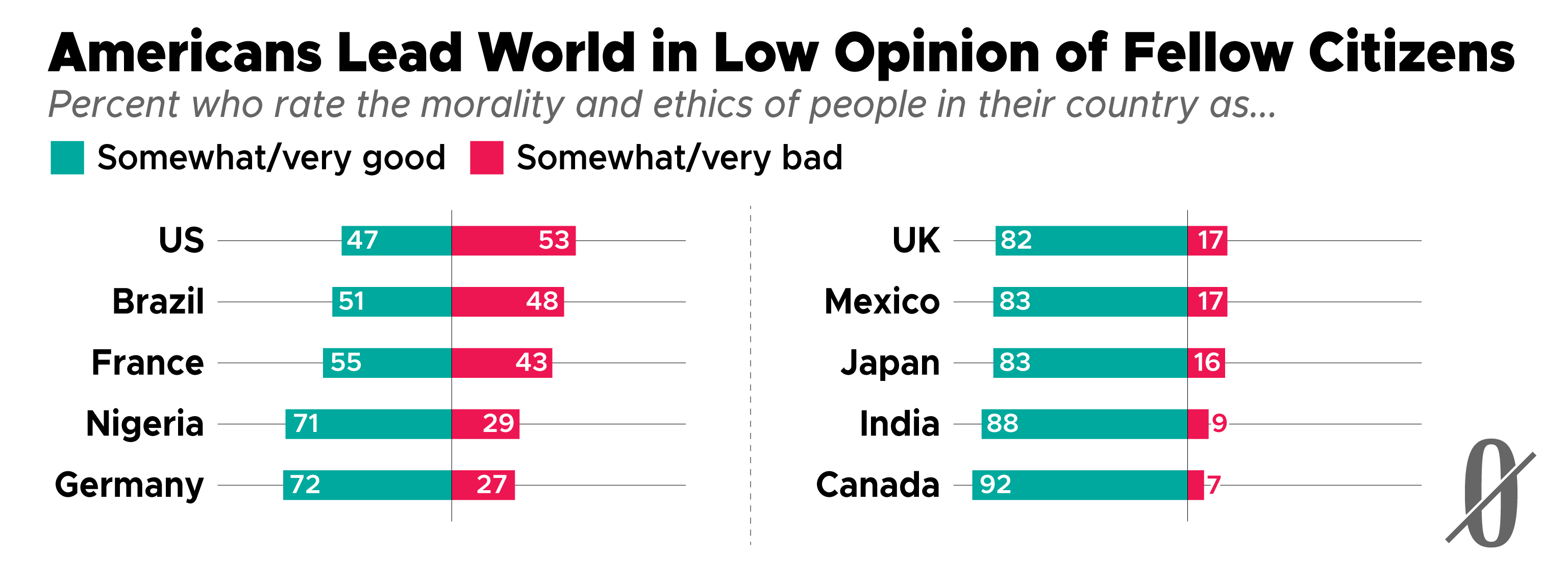
The full Pew survey covered 25 countries, but we’re not cherry picking the data to keep the US in the cherished number one slot. If we’d included all 25 countries, America would still sit at the top of the heap. Another win for the MAGA project.
Banners and graphics by Clark McGillis.
I thought that Germany was the aggressor in the First World War, wanting to establish themselves as the dominant power in Europe. They were ready with armies at the border of France and Belgium and were just looking for a pretext to start an invasion. If you have evidence to the contrary, that Germany was just taking defensive precautions, I would like to hear about it.
It seems pretexts are common, and somewhat necessary, in starting wars. It's not unlike a couple kids fighting, each one claiming "he started it." Claiming "they started it", and convincing folks both internally and internationally that "they" actually started it, seems very important in how wars are won and lost. I think Lincoln would have had a very hard time convincing the North to create armies to invade the South if the South had not fired on Ft. Sumpter. And the American view of WW2 was mostly "stay out of it" until Pearl Harbor was attacked.
Israel and the US attacking Iran during negotiations will probably prove to be a really bad move. It seemed like a good idea strategically but the "they started it" arguments are very weak. US popular support for this war is already very low, and will only get lower as fighting continues. US popular support for Israel is not very high and will only continue to decline. It is likely the US will reach a point where pulling out of the Middle East will seem the best option, and the US dropping support of Israel will become more and more likely. Then Israel will be left on its own. Sure, Israel has the near-term military advantage against its neighbors, but in a war of attrition without US help Israel is likely to lose.
Most countries prefer to stay out of regional conflicts. But if one side "starts it" without clear justification, other countries tend to help out the party that seems to be more "morally correct." This can certainly shift the balance of power.
Thank you. Bob, for your voice, though it may feel like a voice of one crying in the wilderness, one needs to keep crying.
I am also reminded of James Hillman's The Terrible Love of War which got a bad rap back when it came out, mostly because people (wilfully?) misunderstood it. He argued that even those of us opposed to war may get some gratification from it, seeing as so much of our culture is permeated by notions like heroism, glorification of power and violence, nationalism. That the vets report heightened intensity, clarity of purpose, comradeship as opposed to the tedium and confusion of civil life. Hillman argued that we need to confront the psychological purpose war serves before we can truly do away with it. As a self-professed army brat, no doubt you have some interesting thoughts about this, though I am not sure this kind of psychology is right up your alley.