

Save the date(s): I’ll be talking about my new book on AI, The God Test, at Washington DC’s Politics and Prose bookstore this Tuesday evening, July 14, at 7 pm, along with inimitable interlocutor and longtime Washington Post bigthink correspondent Joel Achenbach. Then on Monday July 27th at 7:30 pm, I’ll be discussing the book with Bruce Feiler—author of the recently-discussed-on-the-NonZero-podcast book A Time to Gather--at the 92nd Street Y in New York. If you’re in the neighborhood… (And if you’re not in the neighborhood, you can watch a livestream of the Politics and Prose event via this link.)

Last week Jeremie Harris, a prominent AI policy analyst, said something that wouldn’t be especially notable if he weren’t known as a China hawk. Speaking on Last Week in AI, a podcast he co-hosts, he said, “Starts to feel an awful lot like a treaty with China is going to have to be on the table.” He was talking about a treaty that would take some of the heat out of the US-China “AI race,” allowing both sides to proceed more judiciously—in particular, affording them the time to give increasingly powerful AI models ample vetting before releasing them.
His argument for such a treaty isn’t exactly the argument I’d make. Then again, I’m not a China hawk. And the political importance of his argument lies in the fact that he is one. So it’s worth understanding his logic, which, as I understand it, goes like this:
The Trump administration’s recent decision to keep two powerful AI models off the market while it assessed the risks they pose wasn’t, in principle, crazy. You can complain (as I have done and Harris does) about the way Trump exercised the authority, and you can argue that the government AI review process needs major restructuring. But it wasn’t far fetched for people in the administration to worry that these two models—Anthropic’s Fable and OpenAI’s ChatGPT-5.6—might do great harm if they got into the wrong hands.
After all, Fable is just a version of Anthropic’s famously powerful Mythos model with some guardrails added so the model refuses to help with certain kinds of queries and projects. And guardrails have often been overcome via “jailbreaks.” As Harris notes, “We remain in a world where no one knows how to stop jailbreaks.”
You can imagine various consequent terrors—such as an AI-abetted bioweapon in the hands of some fringe non-state actor—but Harris seems most worried, in the near term, about cyberweapon AIs in the hands of nation-states. He says: “It is 100 percent guaranteed that US adversaries, including specifically the Chinese, will find ways to jailbreak Mythos and any relevant OpenAI models of similar capability, when they are released.”
In other words: Not only was the US government right, in principle, to keep Fable (that is, guardrailed Mythos) off the market for weeks; maybe the model should have stayed off the market longer. On the other hand, that would have come at a cost for Anthropic—and if you made this kind of caution routine, it would come at a cost for the whole American AI industry, and for the pace of American AI progress.
Harris’s conclusion: If you want the US government to proceed as cautiously as the dangers warrant, you need to find a way to greatly reduce the chances that China will successfully exploit this caution—by, for example, racing ahead with its own AI advances, including in cyberweaponry, while American AI keeps being put on pause.
There are two ways to do that, he says. “You either have a treaty with China that’s enforceable and verifiable” or “you degrade, deter, disrupt China’s ability to build AI stuff domestically.” Sooner or later, he says, “you’re either going to need an international treaty or sub-threshold warfare.”
I personally find the sub-threshold warfare option unappealing for a variety of reasons (including the challenge of keeping it sub-threshold). I’m not sure what exact downsides Harris sees in it, but the key thing is that he finds them powerful enough to warrant serious consideration of the alternative, an AI treaty—even though making such a treaty verifiable is, as he puts it, “very hard.”
My own argument for an AI treaty with China would be more general than Harris’s:
Various threats posed by uncontrolled AI cross national borders readily, so advances in AI will make it harder and harder to keep your nation secure via national policy alone; international coordination is required. And for various reasons the logical place for America to start the coordination is with the other AI superpower, China.
But enough about my argument. If a narrower argument will win the hearts and minds of China hawks, let the narrower arguments flourish! And Harris’s position suggests that this can happen—that as more China hawks reach his level of fluency in this technology’s risks, they’ll realize that forging treaties and other agreements with China makes sense.
Do such agreements demand full-fledged rapprochement between the US and China? Not necessarily, no—and that’s a fact that some hawkish but AI-safety-conscious American analysts like to emphasize. Just as we reached arms control agreements with the USSR during the Cold War, they say, we can do such deals with China even if the relationship is deeply adversarial.
My own view—articulated in my book The God Test—is that this kind of surgical collaboration won’t be enough. I think staying secure as AI advances will call for increasingly fine-grained trans-Pacific policy coordination in a context of deep economic, cultural, and scientific engagement. Such engagement, I argue in my book, can bring what I call “organic transparency,” an informal supplement to the kind of transparency provided by formal agreements.
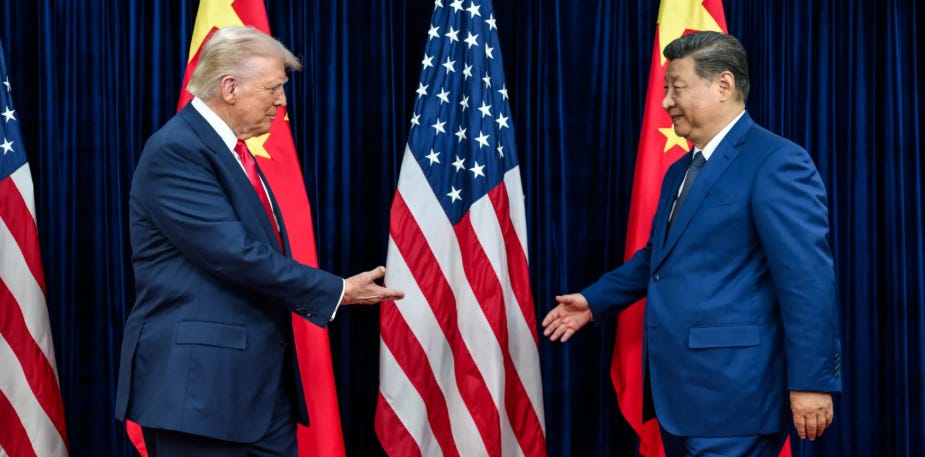
The conversation on China is shifting. More voices in the foreign policy establishment are emphasizing the downsides of a breakneck AI race, and the US has established a formal dialogue with China on AI safety—one of the undercelebrated fruits of Trump’s Beijing summit. This dialogue is for now, I gather, narrowly focused on the kinds of cybersecurity issues that Mythos highlighted. But if the US and China can sustain the dialogue, and avoid contingent disruptions in their relationship, the conversation will naturally grow in scope as advances in AI continue and the non-zero-sum logic behind trans-Pacific collaboration gets stronger.
That’s a big if. The world is a turbulent place, and the US doesn’t currently have the steadiest of hands at the helm. And militarism remains engrained in the Washington mind. But there are signs that enlightenment is starting to dawn.

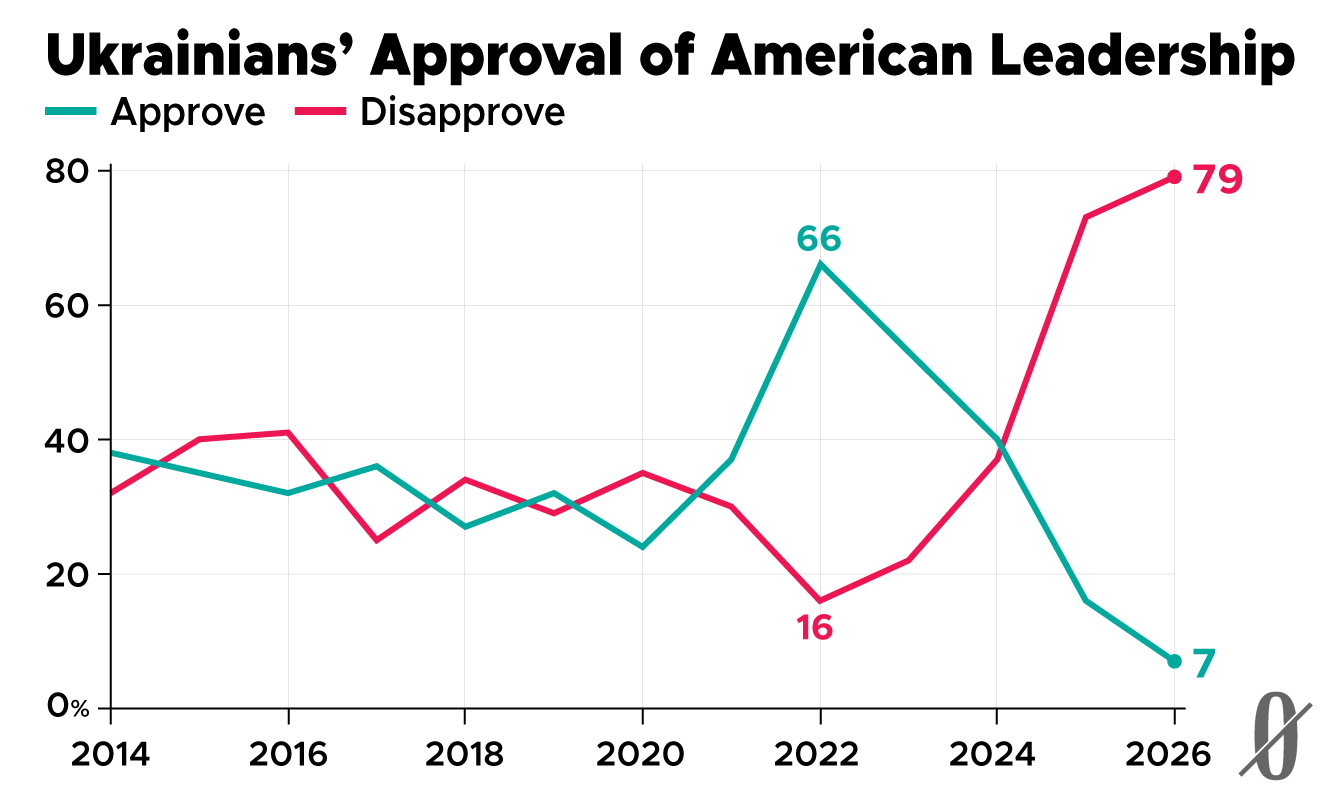
It’s been clear for some time that Donald Trump wouldn’t win a popularity contest in Ukraine—and yet it keeps getting clearer, as in the Gallup poll graph below. However, the latest data points in that graph come from a survey conducted in April—well before Trump suddenly decided to warm up to Ukraine last week. So stay tuned.
For more on the war in Ukraine—including whether the conflict is truly at a stalemate, whether it could lead to a war between Russia and NATO, and the historical roots of today’s animosity between Russia and the West—you can listen to the podcast I posted this week with journalist Leonid Ragozin.
Banners and graphics by Clark McGillis.
China's Moonshot AI Threatens America's Lead
https://www.nytimes.com/2026/07/17/business/china-ai-moonshot-kimi.html?unlocked_article_code=1.yVA.u0ah.-UG0pBFMO3zX&smid=url-share
All of this is contingent on reliability (as with all treaties), which will make it a nonstarter with this administration.
There is a level of self-control required to abide by an international agreement, because it is entirely based on trust until it is based on force (which really isn’t an agreement).
Trump embodies low-trust. He doesn’t believe in rules and disdains obligation. It would be insane for another country to enter into an agreement with him.