

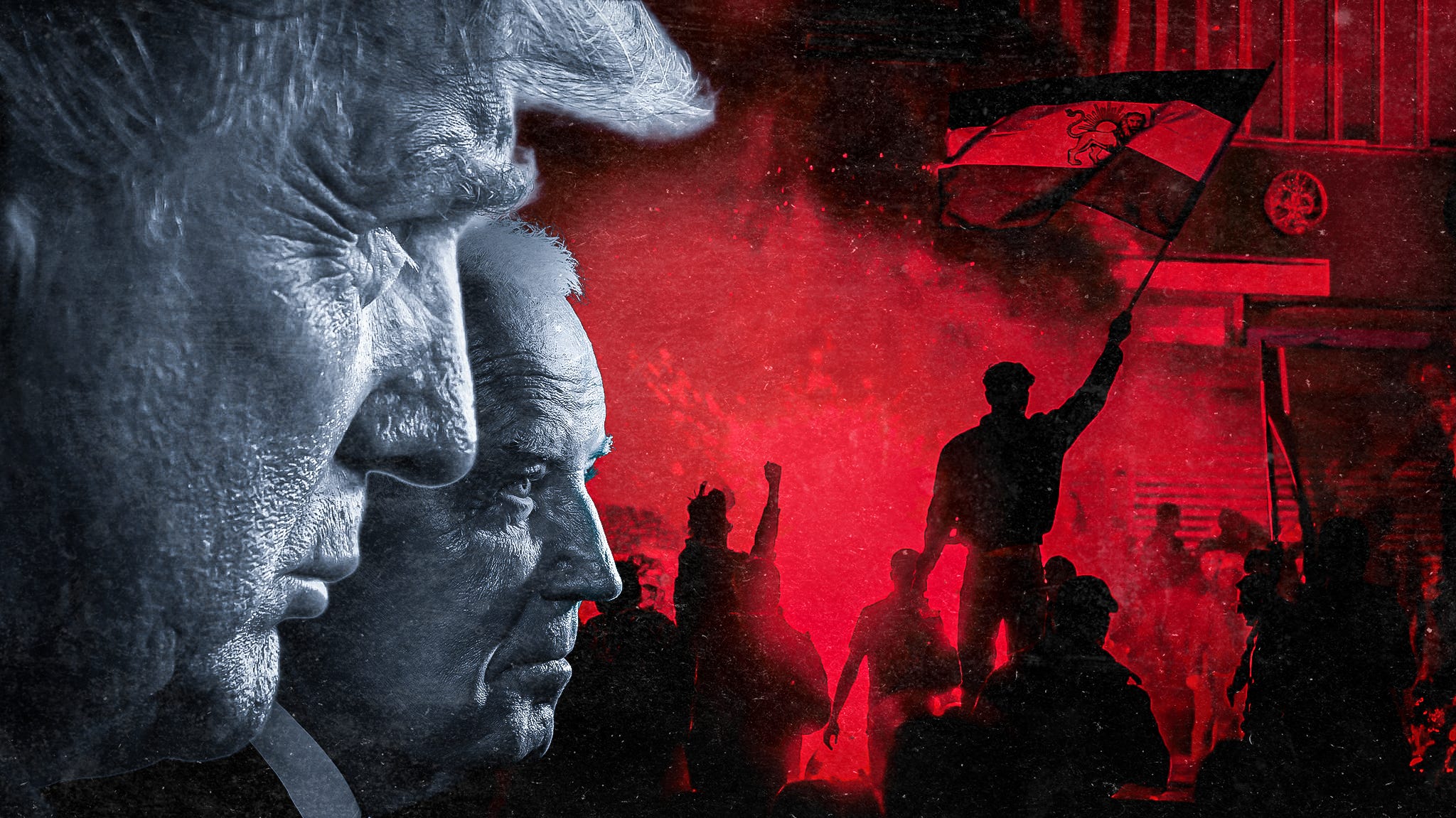
PRESIDENT TRUMP: We will take very strong action [toward Iran if the government starts hanging protesters]. If they do such a thing, we will take very strong action.
JOURNALIST: And this strong action you’re talking about, what’s the endgame?
TRUMP: The endgame is to win. I like winning.
On Tuesday, the same day President Trump gave us the above window into the nature of his concern for Iranian protesters, he posted this on social media: “Iranian Patriots, KEEP PROTESTING - TAKE OVER YOUR INSTITUTIONS!!!... HELP IS ON ITS WAY.”
This post, coming after reports that thousands of protesters had been killed by the regime currently controlling those institutions, may strike you as reckless. You may think, “If the protesters take his advice, he’s morally responsible for any additional deaths that ensue.”
I certainly think that. But Trump’s culpability runs much deeper. During his first term, he altered the course of Iran’s history, strengthening the regime’s hardliners, intensifying the economic suffering of Iranians, and dimming the prospects for rapprochement between Iran and the West. He closed a path that might have led to a freer and more prosperous Iran and opened a path that led to lots of dead Iranian protesters and may yet lead to much worse.
Here was the state of play when Trump entered office nine years ago:
President Obama had performed the quasi-heroic feat of securing a nuclear deal with Iran in the face of stiff domestic political headwinds. So Iran’s nuclear program was now subject to continuous remote monitoring and to regular on-site inspections by the International Atomic Energy Agency, as well as irregular, short-notice inspections. This ensured that uranium enrichment levels were suitable only for a civilian energy program and were nowhere near weapons grade.
This deal entailed the relaxing of sanctions, and that brightened Iran’s economic prospects considerably. The moderates in the Iranian government who had supported the nuclear deal in the face of conservative opposition seemed vindicated and were thus strengthened politically. Many Iran watchers had hopes that Iran’s re-engagement with the world, along with the expected growth of its middle class, would have a liberalizing effect.
Enter Trump. In 2018 he withdrew from the nuclear deal even though Iran was in full compliance with it. He ratcheted up sanctions. In addition to weakening the Iranian economy, this strengthened Iranian hardliners who had warned pro-nuclear-deal moderates against trusting the US. These hardliners could claim even more vindication after Trump shocked the world by assassinating Qasem Soleimani, Iran’s top military commander, via air strike.
Western hardliners—Iran hawks in the US, Europe, and Israel—were also strengthened. After all, the more hardline the Iranian regime, the more things it will do that give Iran hawks rhetorical fodder. Moreover, with the US having abandoned its obligations under the nuclear deal, Iran eventually quit complying with the deal, too. Its nuclear program became more opaque, and it started enriching uranium to higher levels, even if not all the way to weapons grade. For Iran hawks—always eager for reasons to demonize Iran and, ideally, to bomb it—the good news just kept coming.
Enter Joe Biden in 2021. You might think that the guy who had been Obama’s vice president would hasten to re-assemble the part of Obama’s legacy that Trump had gleefully dismantled. He might say to Iran: “Hey, let’s restore the status quo ante—just return to the nuclear deal we had and we’ll relax sanctions accordingly.” But he didn’t. Instead he sought a “longer and stronger” deal that, as Iran hawks had long advocated, would go beyond the nuclear issue and limit conventional weapons, in particular the ballistic missiles that Iran considered a deterrent against Israeli and American attack.
On the NonZero podcast I recently asked Rob Malley, who served as Biden’s special envoy on Iran (and who published an excellent book on the Israel-Palestine conflict that was the main subject of our discussion) what had gone wrong. He said Biden seemed to think that, however ill-advised the US withdrawal from the deal, he might as well use the new sanctions as leverage to see if he could “extract more concessions” than Obama had gotten. It didn’t work. As Malley recalled, “The Iranians were saying, ‘You’re out of your mind. You’re the ones who violated the deal. Now you’re asking us to pay more to get back into it? That doesn’t make any sense.’”
So, says Malley, “I think we lost an opportunity early on… The message that the Iranians got was Biden is just Trump-lite.” Malley isn’t sure Iran would have taken a status-quo-ante deal in the early months of the administration, but he’s sure that, by the time he finally got a green light to pursue something closer to that, Iranian politics had for various reasons become less hospitable to such a thing. “Maybe the moment had passed,” he said.
There’s no doubt that sanctions have had a devastating effect on Iran’s economy. According to The Wall Street Journal, “most economists agree” that “US sanctions that target Iran’s oil industry and financial sector are the main factor crippling the Iranian economy.” There’s also no doubt that economic grievances were the prime mover of the latest protests. On last night’s BBC news, a British woman who was visiting her relatives in Iran last week described the young people who took to the streets: “They were very angry… They said, ‘We don’t have anything to lose. The economy is so terrible, the situation is so terrible, the inflation is so terrible that we don’t have any hope for the future. So we go to the streets, we protest, and we don’t care what will happen to us.’ ”
On the night of the big government crackdown, she was awakened to the sound of gunfire, looked out onto the street, and saw masked men shooting protesters. “It was just like computer games. You shoot, they fall, you shoot, they fall.” American sanctions at work.
Many reports about the protests in mainstream American media note the central role of economic grievances, and some even note that US sanctions helped foster those grievances. But these reports typically mention, as well, government repression and government corruption as common grievances.
And they’re right to mention them. But Trump (and, to a lesser extent, Biden) is responsible for some of that, too. Sanctions on authoritarian countries are famously conducive to corruption. Black markets flourish, and they’re controlled by political and military elites. And, corruption aside, this control adds to the already unfortunate amount of power wielded by these elites. The sanctions on Iran have contributed to the economic clout of Iran’s Revolutionary Guards, whose foot soldiers were presumably doing some of the shooting of those protesters.
And so too with the repression: Trump’s sanctions abetted that not just because they bolstered Iranian hardliners but also because economic misery makes people restive, and restiveness tends to heighten repression—ranging from tighter surveillance to shooting protesters.
Trump didn’t invent American sanctions, which have a long history of counterproductive deployment. But he sure likes them! He did with Cuba what he did with Iran: Restore sanctions Obama had removed. And here again Biden failed to do the right thing. He removed some Trump sanctions, but mainly late in his administration and never entirely. Trump also imposed harsh sanctions on Venezuela in his first term—and Biden again failed to fully undo the damage.
Note the pattern seen in Venezuela, Cuba, and Iran: We impose sanctions that immiserate the people and then cite immiserated people as high on the list of reasons the regime must fall.
Of course, in all of those cases there are other things not to like about the regime as well. The problem is that the strategy of immiserating their people tends to make those other things worse, not better. Even if this collective punishment weren’t morally repugnant—which it is—it would be strategically repugnant.
You’d think we’d have gotten the picture by now. We’ve been sanctioning Cuba for the better part of a century, and the same American political leaders and foreign policy elites who spend no time objecting to that spend lots of time decrying the state of Cuba: It’s a picture of poverty and repression! But they do have a plan: Keep doing what they’ve been doing. The regime will collapse any day now, they say—just as their predecessors, and their predecessors’ predecessors, and so on, said.
They may finally be right. Trump is now blocking the commerce between Venezuela and Cuba that had helped keep the countries afloat in spite of US sanctions. And it’s hard to survive with zero lifelines.
And who knows? Maybe, when the Cuban regime falls, it will be replaced by something much better. But if history is any guide, it won’t be. The sudden fall of authoritarian regimes usually doesn’t work out well. And, in any event, things would have to work out very well, for a very long time, to make up for the generations of suffering the US has inflicted on Cuba.
We’ll never know if the hopes for Iran that Obama’s nuclear deal fostered would have been realized had Trump not intervened. Maybe commercial engagement with the world wouldn’t have had any internally liberalizing effect, politically or even economically. And maybe more economic interdependence with other countries wouldn’t have moderated Iran’s policies toward them.
But even if things didn’t pan out on those fronts, it seems safe to say that Iran’s people would be much better off economically and no worse off politically, and some now-dead protesters would still be alive. And as of today—with another war in the Middle East one distinct near-term possibility and the violent and chaotic implosion of Iran another one—that scenario doesn’t sound so bad.


The Good Effect
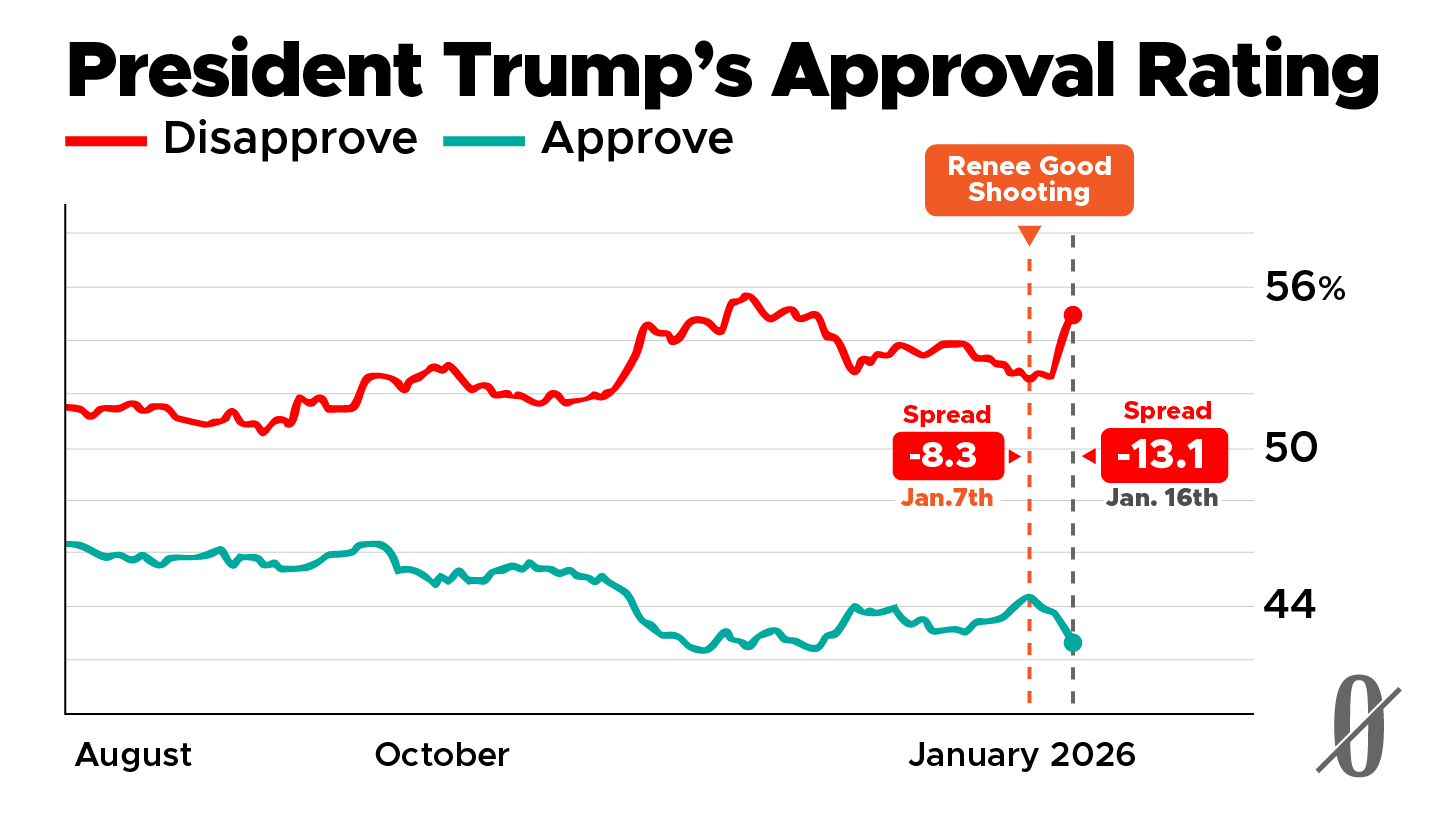
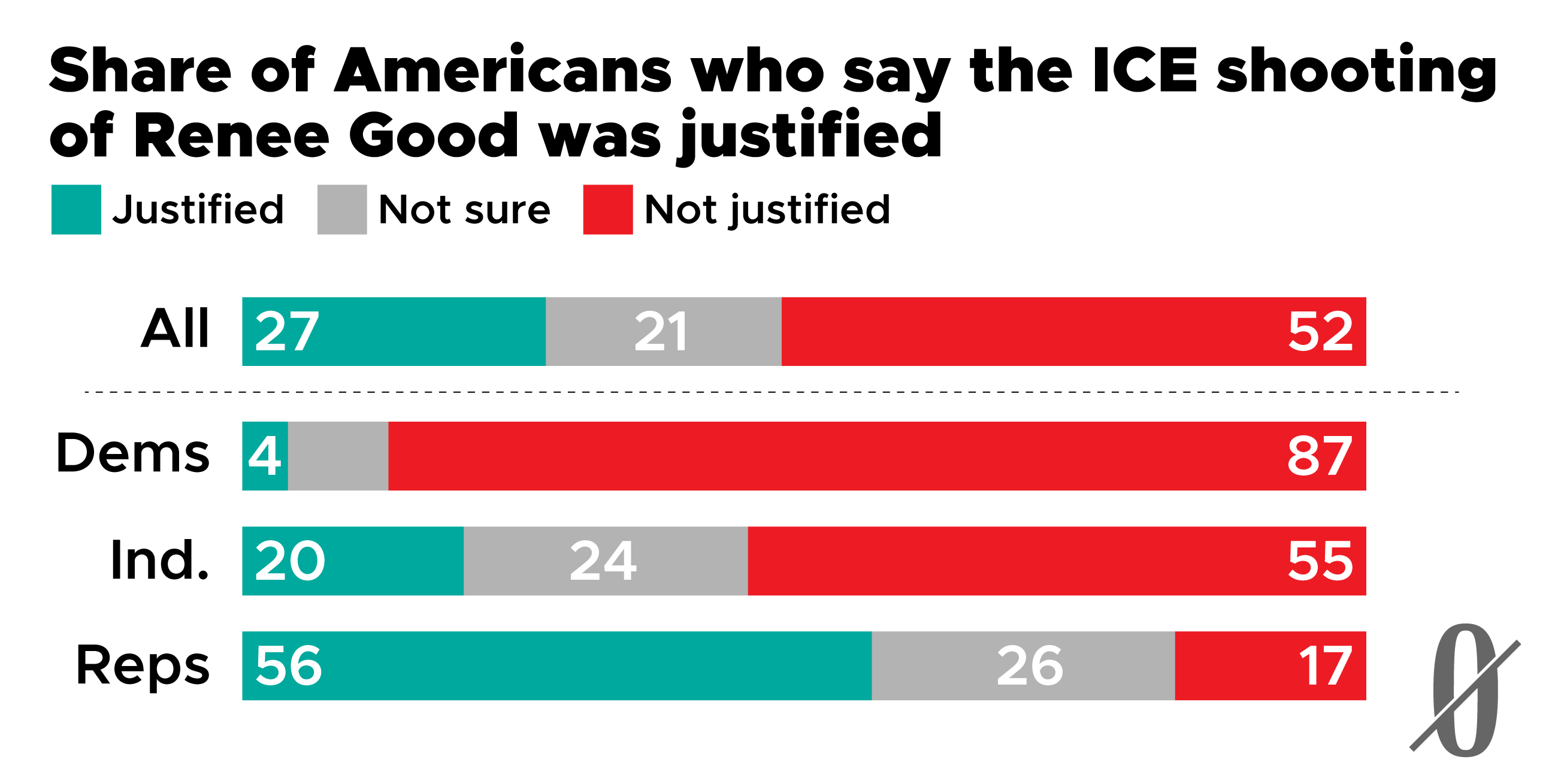
The Trump administration’s full-throated defense of the killing of Renee Good—and the full throated attacks on Good by numerous administration officials—may not turn out to be great politics. A much larger portion of Americans think the shooting was unjustified than think it was justified (see below). And, according to the RealClearPolitics aggregation of polls (above), since Jan. 7, the day of the shooting, Trump’s approval rating has fallen from 44.3 to 42.2, reaching its lowest level since he was sworn in a year ago.
Weiss Watch
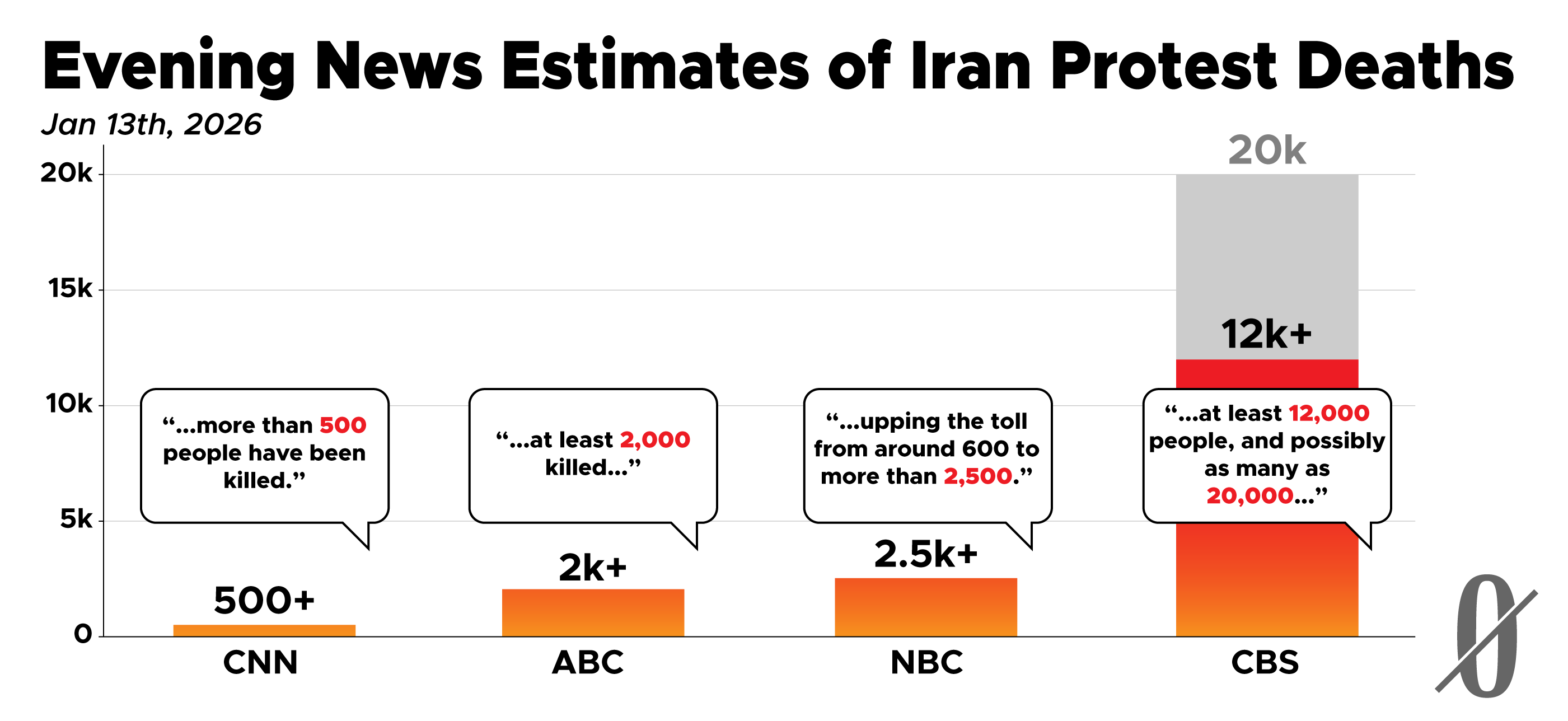
When Bari Weiss became head of CBS News three months ago, some of her critics predicted that its broadcasts would start exhibiting a pro-Israel bias. After all, these critics contend, both her ideological history and the ideological history of billionaire Larry Ellison, whose son hired Weiss after the Ellisons acquired CBS owner Paramount, suggest as much. This week some of these critics saw coverage of the Iran protests as evidence that they were right—citing, in particular, its reporting on how many protesters the regime killed during its crackdown.
The graph below doesn’t by itself settle the matter. But more evidence may be coming in. If Paramount succeeds in its bid for Warner Brothers Discovery, the Ellison family will control CNN, a Warner property. So, if Weiss’s critics are right, the kind of gap you see between CNN and CBS reporting in this graph should then start to close. Stay tuned.
Banners and graphics by Clark McGillis.
Crazy how absent this perspective on US policy towards Iran is from the current media coverage. Most outlets are totally fine letting Trump cosplay as some kind of humanitarian, as though we have an aircraft carrier now en route to ME *just in case* the authorities in Iran decide to execute some people.
Thanks for keeping me sane, RW!
Is there a paragraph missing to explain the AI graph?