

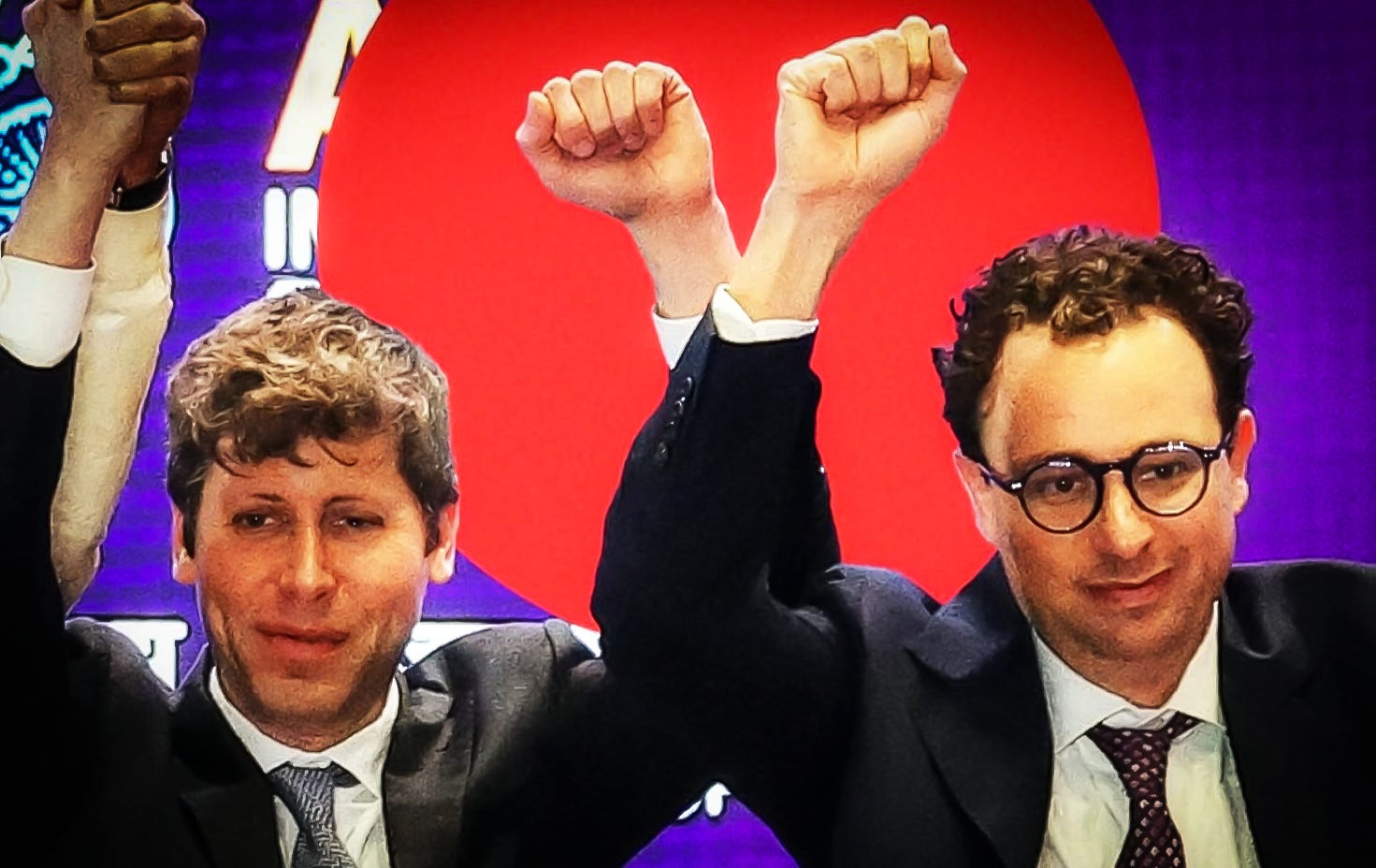
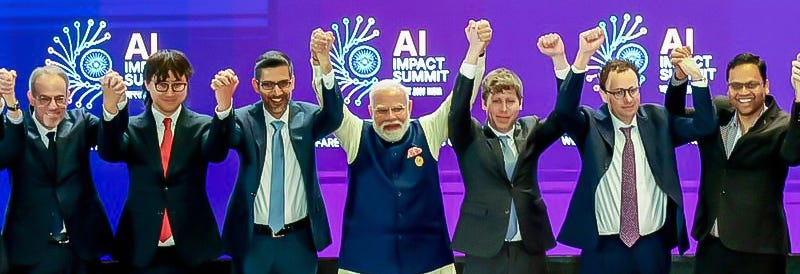
There was an awkward moment at this week’s “AI Impact Summit” in India. Prime Minister Narendra Modi stood on stage alongside a dozen industry leaders and encouraged them to hold hands, but OpenAI CEO Sam Altman and Anthropic CEO Dario Amodei, who are known to loathe each other, couldn’t bring themselves to make physical contact. So there was a conspicuously missing link in the chain of concord:
But there’s one constant note of harmony between Altman and Amodei. It’s something that seems to unite Silicon Valley more broadly: the conviction that America’s development of AI needs to move at warp speed.
Many of the people who hold this view acknowledge that approaching the goal line—“superintelligence” or “artificial general intelligence” or whatever hazily defined threshold is named—could bring new and grave threats to society, threats we don’t yet know how to handle. As Altman—in a formulation I definitely didn’t find reassuring—put it this week in New Delhi: “We’ll probably need superintelligence to help us figure out the new governance mechanisms” that superintelligence will demand.
In a way it’s impressive how tech titans manage to combine doubts about where this is all heading with a firm commitment to speeding up the journey, typically by clearing away burdensome regulation or expanding our capacity for powering data centers. Eric Schmidt, former CEO of Google, has said, “We don’t know what AGI or superintelligence will ultimately deliver. But we know it’s coming. And we must plan now to make sure we have the energy infrastructure to support it”—an infrastructure that, of course, hastens the arrival of this unknowable fate.
Schmidt got a shoutout this week from an account on X called Tesla Owners [of] Silicon Valley, which has 1.4 million followers and sometimes sings the praises of solar-powered orbital data centers (which, coincidentally, would be launched into space by a company owned by the man who runs Tesla). The account tweeted a clip of Schmidt saying the US is “running out of electricity.” Elaborating, he said the country needs to boost its power capacity by 92 gigawatts to accommodate the necessary growth of AI. And “the average nuclear power plant is 1.5 gigawatts. You see the problem.”
Actually, I don’t. Because it’s only a problem if you want to embark on a headlong rush into the unknown, and I’m just not feeling that urge.
But the people who do see the problem—who do favor a headlong rush—have their reasons. Far and away the most common reason is this: America must accelerate in order to beat China to the decisive AI threshold that will grant hegemonic power to whichever nation gets there first.
Traditionally, I’ve questioned the wisdom of this logic by noting the perils of headlong rushes—the possibly irretrievable destabilization that rapid social, political, and geopolitical change of great magnitude could bring. Today I want to take a new approach to questioning the wisdom of this logic: Leave aside the perils of a reckless sprint toward AI-powered American dominance of Planet Earth—Would this kind of dominance, if achieved, be a good thing?
Affirmative answers to this question typically rest on the idea that the US is in some sense better than China and will thus handle the dominance granted by AI supremacy more virtuously and responsibly than China would. More specifically, the claim is that China would use dominance to spread authoritarianism and/or autocracy, whether via soft power, coercion, or just by taking over the planet.
I personally think this assumption could use more critical scrutiny than it’s gotten, but I’m not going to provide that service now. For present purposes, let’s stipulate that China’s more authoritarian and autocratic system makes the prospect of China beating us to some hugely empowering AI threshold distinctively concerning. My question is: Why isn’t the prospect of the US reaching the threshold first also concerning, just in a different way?
Let’s review some of President Trump’s achievements during the first year of his second term:
He launched an unprovoked air attack on Iran in June and an unprovoked invasion of Venezuela in January, and now he’s amassing a mammoth concentration of military force in the Middle East with an eye to attacking Iran again—which would make a third violation of the UN Charter’s ban on unprovoked transborder aggression in a span of only 14 months. Impressive!
China, meanwhile, hasn’t launched a military assault on a sovereign nation since 1979, when it invaded Vietnam and then withdrew a month later.
It would be comforting to think that America’s lawlessness is a transient product of the Trump era. But in fact, the US has a long history of illegal transborder aggression, even if Trump now shows signs of picking up the pace. Here are some violations of the UN Charter committed by America since China’s 1979 violation: the invasion of Grenada in 1983; the invasion of Panama in 1989; the bombing of Serbia in 1999 (not to be confused with the 1995 bombing of Bosnia, which was authorized by the UN Security Council and therefore legal); the invasion of Iraq in 2003; and Trump’s first-term air strike on Iraq in 2020, which killed five Iraqis and five Iranians, including the target, Iran’s top military commander.
And this list doesn’t include the interventions that were arguably illegal (like Obama’s sending troops to Syria and also adding fuel to the Syrian civil war with a massive infusion of weapons, or Obama’s arguably exceeding the 2011 UN Security Council mandate that authorized a “humanitarian” intervention in Libya that then morphed into a regime change operation).
This list also doesn’t include the various acts of economic strangulation the US has perpetrated—such as one that that ultimately led to the death of thousands of Iranian protesters, or the one that led to this headline in the New York Times this week: “Cuba Nears Collapse as a New US Blockade Strangles the Country.”
Suppose you’re an extraterrestrial, with no allegiance to China or the US, and you’ve been observing Planet Earth for the past half century, and a friend says to you, “So which nation would do more damage to the planet if it suddenly had an unprecedentedly powerful new technology that gave it planet-wide hegemony?” Is it really obvious that the logical answer would be China?
If judging nations this way—by their compliance with the most fundamental principle of international law—seems strange, that may be because it hasn’t been a common pastime in America. (After Russia’s invasion of Ukraine, there was more American bemoaning of the invasion of a democracy by an autocracy than of the invasion of a sovereign nation, even though sovereignty, not democracy, is what made the invasion illegal.) And one reason this mode of judgment hasn’t been common in America is that it’s not flattering to America.
Another reason is that judging nations by their internal affairs rather than their external conduct makes it easier to condemn China, and lately some powerful shapers of American discourse have had an interest in promulgating a dark view of China. AI companies and other tech companies can make donations to think tanks and politicians, after all.
I’m not saying that the thought of China reaching some threshold of transformative AI power before the US does fills me with comfort. There are, again, distinctive sets of concerns about either side achieving overwhelming AI superiority, and I don’t think either set can be wholly dismissed, even if the American tendency has been to overstate one set and understate the other. What’s more, the race itself is inherently dangerous, since the side that’s losing could decide that it has to resort to extreme measures if it wants to escape subjugation.
All of this explains why I favor talking things over with China, the long term goal being some degree of international governance of a technology that is in some ways unprecedentedly powerful. And that discussion, as I argued last week, is one Trump may yet embark on, notwithstanding his inordinate (even by American standards) lawlessness and his professed disdain for global governance.

The visual display of quantitative information can be powerful; a glance at a good graph can give you the big picture fast. By the same token, visually displayed data can be subtly, yet powerfully, misleading. If you want to see what I mean, take a quick look at the two-graph graphic below, which appeared in the New York Times, then read my commentary on it, and then look at NZN Graphics Czar Clark McGillis’s rendering of the same data in a different form, below the commentary.
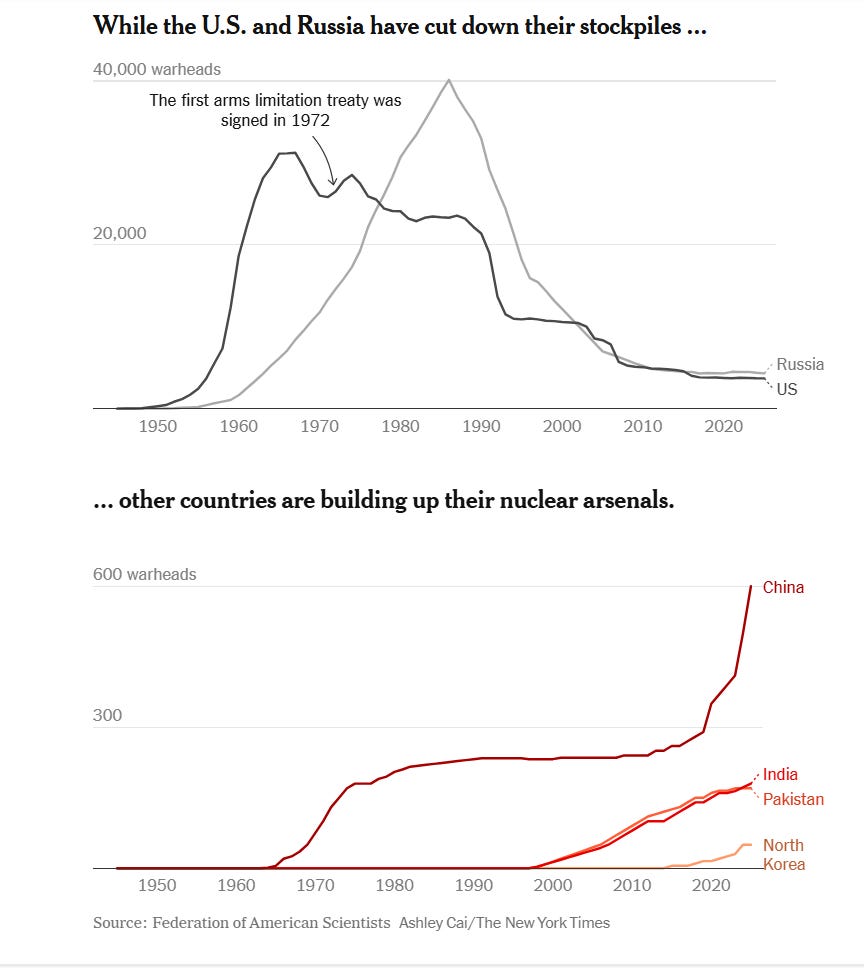
At a quick glance, the two graphs above convey a sense that China is close to catching up to the US on the nuclear warhead front. That, of course, is because the scales on the vertical axes are different. Using those two different scales was a defensible decision; this approach clearly captures the steep slope of China’s growth curve—and, as you can see by looking at the NZN version of the graph below, some detail about nations with smaller nuclear stockpiles is lost once you array all the data on the same vertical axis. Still, since the story the Times graphic accompanied was more about the three nuclear superpowers than about any other cluster of nations, I think there’s a case for making those three superpowers easily comparable at a glance.
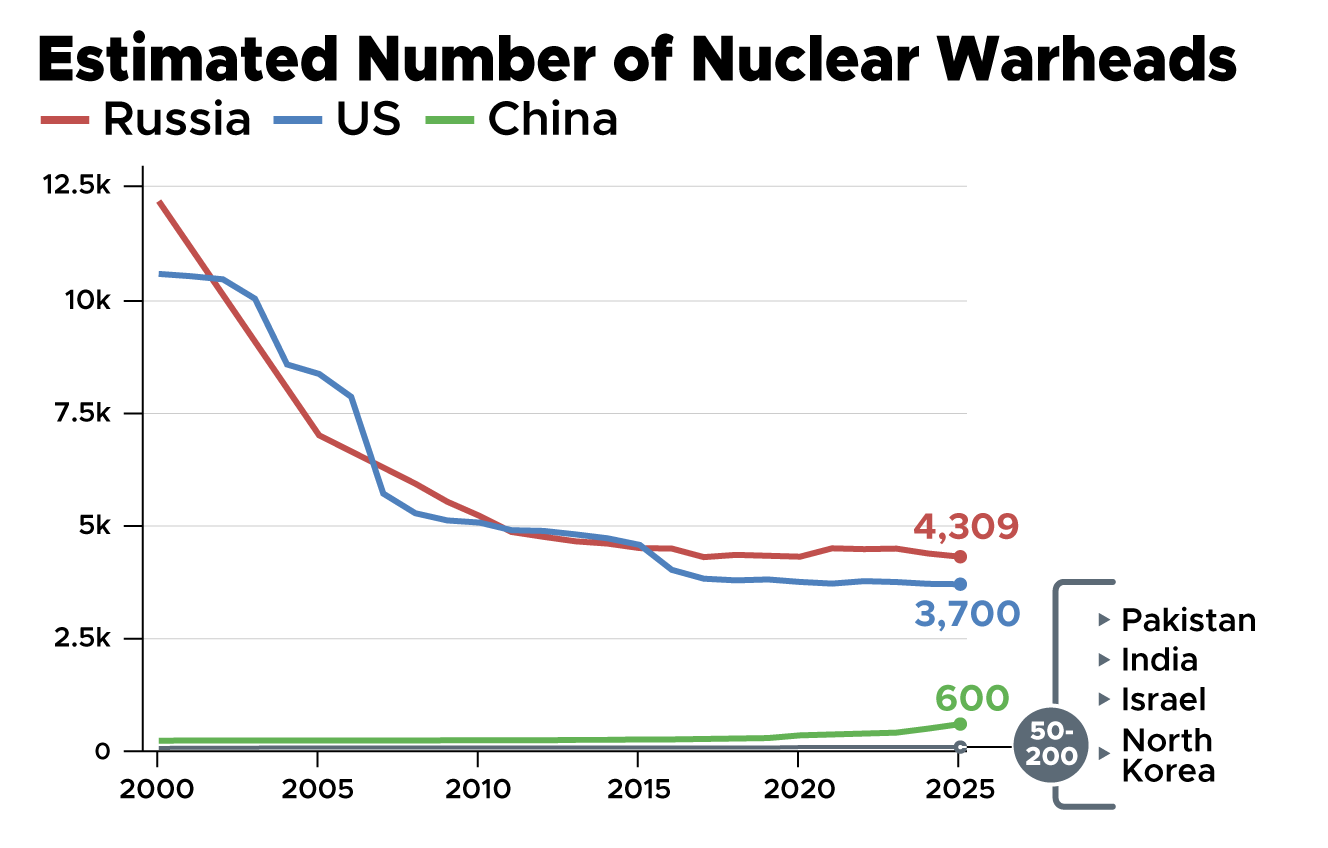
By the way, we’ve made one other amendment to the Times graphic: We’ve added Israel to the mix. The Times’s decision to omit Israel was in principle defensible, since Israel is the only nuclear power that hasn’t acknowledged having nuclear weapons. Still, we know for sure that Israel has nuclear weapons—and, though we don’t know the exact number, that’s also true of countries like North Korea, where the Times graph relies on an estimate. Moreover, with the US now preparing to bomb Iran partly on grounds that it hasn’t entirely abandoned uranium enrichment, the fact that Iran’s big regional adversary has nuclear weapons is particularly timely information. So leaving Israel out of the graph seems to me like a pretty bad call on the part of the Times.

Banners and graphics by Clark McGillis.
"If judging nations ... by their compliance with the most fundamental principle of international law seems strange, that may be because it hasn’t been a common pastime in America."
But of course it hasn't. Who needs international law? We are the indispensable nation. We are the exceptional nation. We are unique in all of history in our devotion to all good things. All great American statesmen, from Henry Kissinger to Madeline Albright to Marco Rubio, knew that. All responsible experts eligible to write for Foreign Affairs or the New York Times know that. Get hip, Robert.